
The conversation around connectivity has for years now revolved around a simple metric: bandwidth.
How fast is the circuit?
How much does it cost?
Can we get a better price per megabit?
But the economics of connectivity have changed. Circuit prices continue to fall, while the cost of the applications that run on those circuits keeps rising. Today, businesses routinely spend thousands of dollars per month on cloud tools that power their operations: VoIP platforms, point-of-sale systems, electronic medical records, collaboration tools, and SaaS platforms that run entire departments.
The real question is no longer how much the circuit costs. It’s how well the network protects the applications that run on it.
When Cheaper Circuits Change the Wrong Metric
Over the past decade, broadband competition and wireless innovation have driven down the price of connectivity. Fiber, cable, fixed wireless, and even satellite have made bandwidth more accessible and affordable than ever before.
On the surface, that seems like good news. Lower circuit costs should make networks less expensive to operate.
But there’s a hidden consequence: when bandwidth becomes inexpensive, it also becomes easy to undervalue the network itself.
In many conversations, optimization technologies like SD-WAN or intelligent traffic management get framed as an “extra cost” on top of the circuit. The logic becomes simple:
If the internet connection is cheap, why spend more on the network?
That framing misses the real financial picture.
Because the most valuable assets in the environment aren’t the circuits, they’re the applications.
The Real Cost Center Is the Application Layer
Businesses now run on cloud platforms.
Phone systems, payment processing, scheduling software, collaboration tools, customer databases, and analytics dashboards all live in the cloud. For many organizations, these tools represent the majority of their technology investment.
And they are highly sensitive to network performance.
When latency spikes, VoIP calls break up.
When packet loss increases, video meetings freeze.
When jitter appears, POS transactions stall.
When circuits degrade, SaaS applications slow down.
These disruptions rarely appear on a bandwidth chart. But they have a very real impact on productivity, customer experience, and revenue.
That’s why the conversation about network investment needs to shift away from the cost of circuits, and toward the value of protecting application performance.
Reframing the Spend Conversation
Ryan Beer, Director of Strategic Partnerships at Bigleaf, often sees this shift change the tone of customer discussions immediately. As he stated in our recent Performance Optimization webinar:
“When you’re attaching those conversations to the cloud side of their network, not so much the circuit side… that becomes a much more approachable conversation.”
Instead of asking, “Why should we spend more on the network?” the conversation becomes:
How do we protect the applications the business depends on every day?
Viewed this way, network optimization stops looking like a cost add-on and starts looking like operational insurance.
A modest monthly investment in performance optimization protects thousands of dollars’ worth of business-critical software.
Or, as Bigleaf CMO Lori Stout puts it:
“It’s pennies on the dollar to protect that investment.”
Start Gathering Cloud Invoices, Not Just ISP Invoices
Many partners instinctively gather ISP invoices when evaluating a customer environment. It’s a natural starting point; connectivity has traditionally been the foundation of the network conversation.
But in modern cloud-driven environments, those invoices only tell part of the story.
To fully understand the value of network optimization, partners should also look at:
- VoIP platform costs
- POS and payment systems
- EMR or EHR platforms in healthcare
- SaaS platforms like CRM, ERP, or collaboration tools
- Industry-specific cloud applications
When you place the cost of connectivity next to the cost of these applications, the network suddenly becomes a much smaller portion of the technology budget.
And protecting that investment becomes an obvious priority.
Protecting the Applications That Run the Business
Consider a few common examples.
A restaurant relying on cloud-based POS systems can lose hundreds of dollars in transactions during even a brief connectivity disruption.
A healthcare clinic using electronic medical records depends on stable network performance for patient scheduling, documentation, and billing.
Retail stores running cloud inventory systems or payment platforms cannot afford transaction delays during peak hours.
In each case, the network is not just a utility. It’s the delivery system for the applications that generate revenue and maintain operations.
Ensuring those applications perform consistently isn’t a luxury; it’s a business requirement.
Turn Network Performance Challenges into Revenue Opportunities
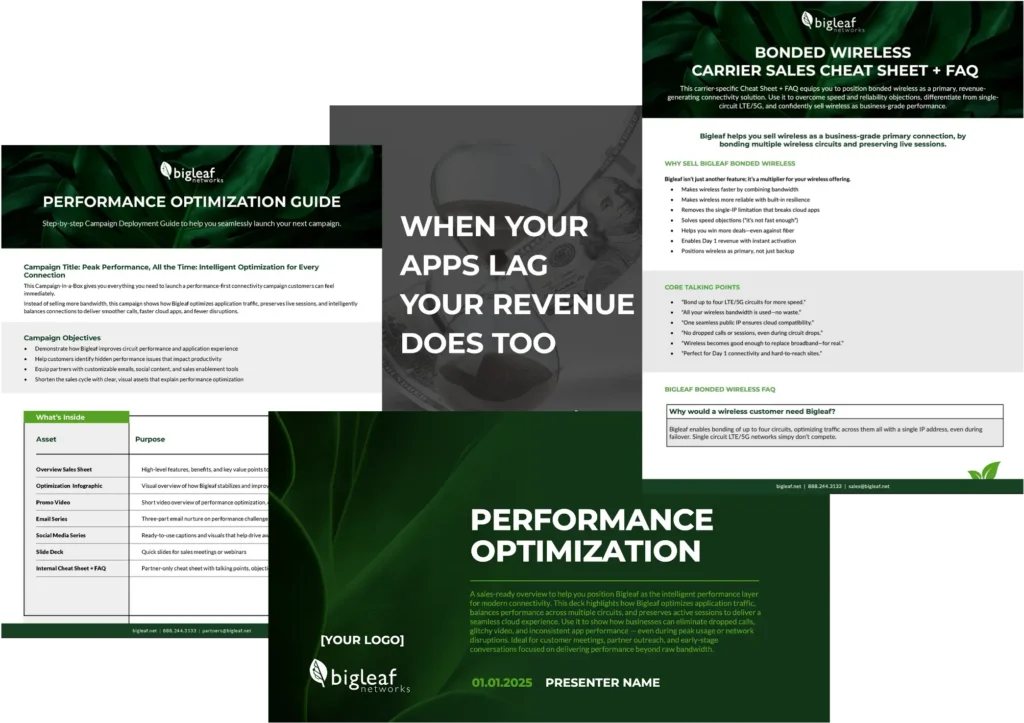
Bigleaf’s Performance Optimization Campaign-in-a-Box gives partners everything they need to shift the conversation from bandwidth to application experience — enabling revenue-focused conversations that drive real business outcomes, including:
Co-branded sales sheets, infographics, and slide decks
A ready-to-deploy webinar kit (title, description, banner, slide deck, and speaker notes)
A multi-touch email series focused on application performance, packet loss, jitter, and real-world user impact
Social posts, companion videos, and industry-specific messaging
A complete deployment guide and recommended 4-week launch timeline
Whether you’re a one-person shop or a full sales team, this campaign equips you to identify performance issues before users feel them, reframe network conversations around business impact, and drive higher-value opportunities — all with less marketing lift.
The Conversation That Wins
As connectivity becomes more commoditized, partners have an opportunity to elevate the conversation.
Instead of competing on bandwidth speeds or circuit pricing, the discussion shifts to something far more valuable: application performance and business continuity.
The question becomes:
How do we ensure the tools that run your business always perform the way they should?
When framed this way, network optimization is no longer an optional add-on. It’s the layer that protects the investments organizations have already made in their cloud infrastructure.
And in a world where applications power everything from phone calls to revenue transactions, protecting those investments is a conversation every business understands.
See It in Action
Network performance isn’t just about staying online.
It’s about helping your customers deliver reliable, business-critical application experiences — by eliminating packet loss, jitter, and instability before users feel the impact.
And when you can lead with performance, you gain the edge to open earlier, more valuable conversations.
To learn more, watch the on-demand webinar: