
Cloud Apps Expect Fiber. Your Network Doesn’t Have To Provide It.
Cloud applications require stable connections: consistent latency, limited jitter, reliable throughput, and uninterrupted sessions. But wireless circuits, especially LEO satellite, naturally fluctuate. Those shifts create performance problems such as:- Distorted VoIP calls
- Freezing or pixelated Zoom/Teams sessions
- Slow or failed SaaS logins
- Interrupted workflows
- Sync failures and reauth loops
How Bigleaf Makes LEO and Wireless Feel Like Fiber
Bigleaf overlays real-time intelligence, prioritization, and smoothing across wireless links, creating a fiber-like experience without changing the underlying circuit. Here’s how: 1. QoS by Application Class: Prioritize What Matters Most Bigleaf automatically identifies traffic classes (VoIP, video, SaaS, collaboration tools, point-of-sale, file sync, streaming, and more) without relying on port mappings or manual rules. MSPs can instantly assign priority tiers:- Real-time apps get top priority
- Business-critical SaaS gets stable mid-tier
- Bulk or non-essential traffic gets deprioritized
- Video meetings don’t freeze
- VoIP calls remain clear
- SaaS stays responsive
- Workflows stay uninterrupted
- Remote desktops
- Telehealth
- Financial transactions
- POS
- Long-running cloud sessions
- Fewer call issues
- Less video disruption
- Higher overall throughput
- More predictable cloud performance
Best Practices: Delivering VoIP & Video Excellence Over LEO
VoIP and video conferencing are often the first apps to suffer on unoptimized wireless. With Bigleaf, MSPs can deliver exceptionally high-quality experiences by applying a few proven practices.Prioritize Real-Time Traffic Above Everything Else Give VoIP and conferencing the highest QoS tier so they cut through congestion and jitter.
Use Redundant Links When Available Combining LEO with 5G or LTE dramatically increases call stability and uptime.
Shape Bulk and Streaming Traffic Rate-limit or deprioritize heavy apps, like OS updates, streaming, cloud sync tools, and large file transfers, so they can’t degrade call quality.
Monitor Real-Time Metrics Bigleaf’s Cloud Connect dashboard shows jitter, latency, traffic categories, and more, helping MSPs quickly identify issues.
With these best practices, video meetings and calls feel like they’re running on fiber, even if the site is served by a satellite dish.Why Wireless-First Businesses Need Bigleaf More Than Ever
Cloud apps aren’t getting lighter; they’re becoming more real-time, interactive, and bandwidth sensitive. Meanwhile, wireless adoption is accelerating across industries:- Retail
- Construction
- Healthcare
- Remote offices
- Pop-ups
- Field operations
- Mobile and temporary sites
- Predictable performance
- Stable app experiences
- Resilience during fluctuations
- Visibility into behavior
- Guaranteed uptime across circuits
Make Wireless Work Like Fiber, No Matter Where You Deploy
Wireless-first connectivity opens new possibilities, but without stability and optimization, it can’t support the cloud workloads businesses rely on. Bigleaf changes the equation. With dynamic QoS, jitter smoothing, intelligent load balancing, and real-time traffic classification, Bigleaf turns LEO and wireless circuits into something rare: Wireless that behaves like fiber. Cloud apps stay fast, stable, and reliable. VoIP and Zoom perform flawlessly. Businesses get the uptime they expect. And MSPs get fewer tickets, fewer headaches, and more satisfied customers. Wireless-first is here to stay. Bigleaf makes it ready for business.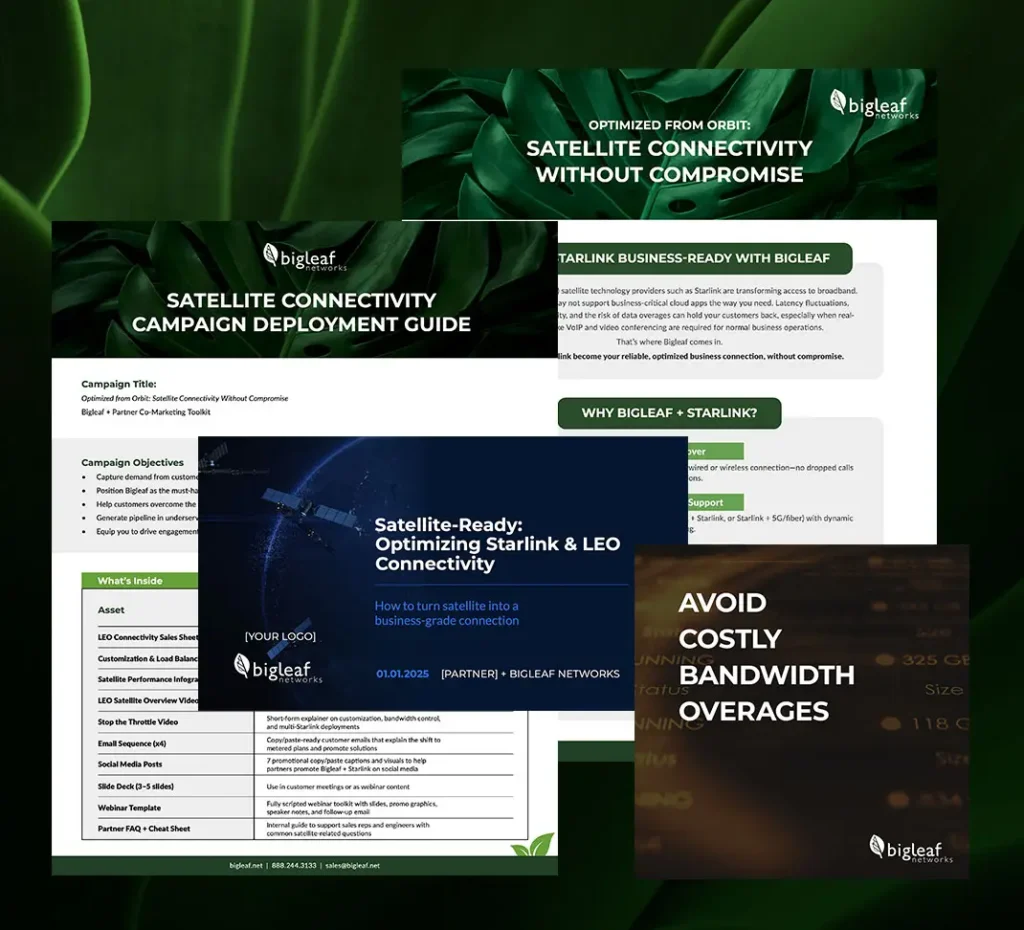
Turn Satellite Challenges into Sales Wins
Bigleaf’s Satellite Connectivity Campaign-in-a-Box gives partners everything they need to bring the Bigleaf + Starlink value story to market fast, including:
Co-branded sales sheets, infographics, and slide decks
A ready-to-deploy webinar kit (title, description, banner, slide deck, and speaker notes)
A four-part email series designed to address metered plans, remote-site challenges, and Bigleaf optimization
Social posts, companion videos, and industry-specific messaging
A complete deployment guide and recommended 4-week launch timeline
Whether you’re a one-person shop or a full sales team, this campaign equips you to capture satellite-driven demand, educate customers on metered-plan impacts, and win high-value deals in remote or bandwidth-constrained locations — all with less marketing lift.
See It in Action
Satellite connectivity isn’t just about getting online anywhere.
It’s about helping your customers get reliable, business-grade performance from Starlink and other LEO services—while giving you the edge to win more of those opportunities.
To learn more now, watch the on-demand webinar: