
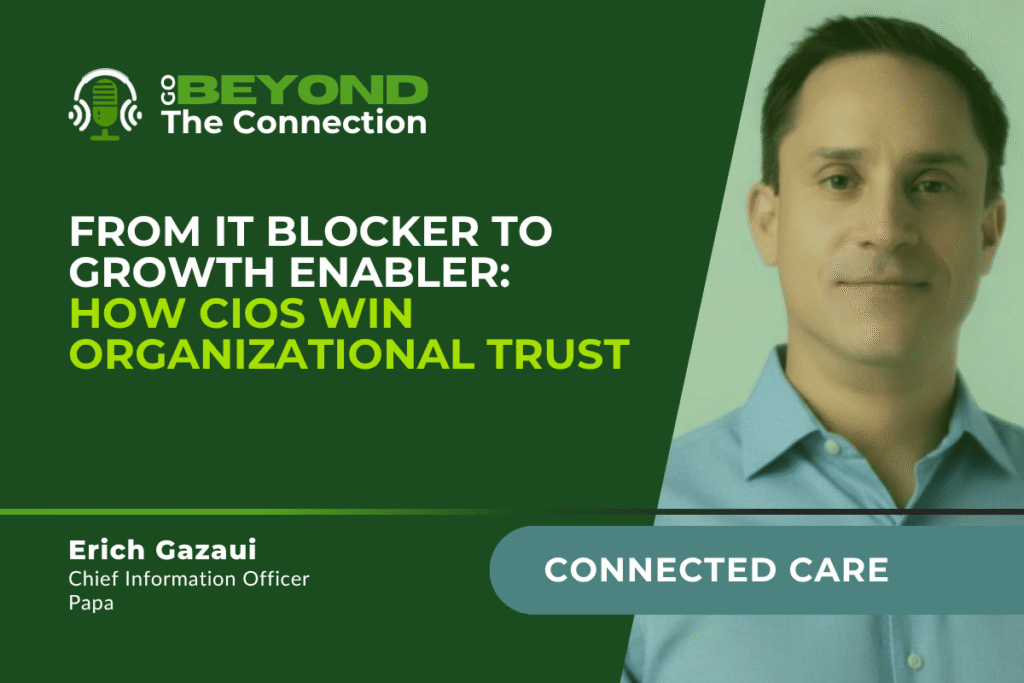
Why the CIO Mandate Has Nothing to Do With Technology
There is a pattern Erich Gazaui has seen at every company he has joined. The IT organization is treated as a bottleneck. Teams route around it when they can. When they cannot, they wait, frustrated. The unspoken assumption is that working with IT means slowing down.
Gazaui, Chief Information Officer at Papa, has spent his career dismantling that assumption. His approach is not primarily technical. It is relational, and it connects directly to two challenges he sees playing out in parallel across organizations right now: how IT teams earn the trust required to drive real adoption, and how healthcare technology leaders navigate the governance pressures that come with AI. Research from MIT Sloan reflects the same shift. The CIO role has been evolving from technical expert to enterprise business leader, and the differentiator is almost always cross-functional relationship building, not technical depth.
The Trust Problem Behind Shadow IT
Shadow IT does not start because employees want to cause problems. It starts because someone needed an answer faster than the process allowed, so they found another way. Gazaui is direct about what that signals: the IT organization has a sentiment problem, not a systems problem.
His prescription is deliberate relationship investment. Before pushing any technical initiative, he focuses on building what he calls bridges, the kind of working trust that makes other teams feel like IT is something they get to work with, not something they have to go through. He measures progress not by system uptime but by whether colleagues are coming to his team proactively, excited about what they could build together.
The practical payoff is real. When relationship capital is high, fast feedback loops become possible. His team can stand up a proof of concept quickly, put something tangible in front of a stakeholder, and give that person immediate signal on whether their idea has legs. That speed changes how the organization experiences IT, and over time, it changes what IT gets invited into.
AI Governance as a Leadership Stance
The pressure around AI is not abstract for Gazaui. At Papa, he operates in a regulated healthcare environment where external-facing AI deployment requires careful deliberation. Health plan members are involved. Safety is non-negotiable. He describes a healthy, necessary hesitation when it comes to what the organization puts in front of constituents externally.
But internally, he is moving faster. With smaller teams and closer oversight, he can ensure people understand what AI tools are, how to use them responsibly, and where the boundaries are. He draws a direct line between that internal education work and the broader security posture his team maintains. The same vigilance that teaches employees to scrutinize an unfamiliar app download applies to understanding when and how an AI tool is operating on them.
His stance is not cautious for its own sake. He describes his job as finding the path to yes, a posture that treats governance as the guardrail that makes innovation possible rather than the wall that stops it. McKinsey’s research on the evolving CIO mandate points to the same conclusion: the technology leaders driving the most business value are the ones who combine governance fluency with a genuine bias toward enabling their organizations, not restricting them. Healthcare organizations that embrace that frame will arrive at their innovation goals faster because they will not have to backtrack and remediate decisions made without governance in place.
“In healthcare, safety is paramount. When it comes to what’s externally facing, there’s a very healthy and necessary hesitation, or at least a desire to move slowly and understand.” — Erich Gazaui, Chief Information Officer, Papa
Both of these themes, trust-building and governance, point toward the same underlying idea. Technology leadership at its best is not about the technology. It is about creating the conditions under which other people can do their best work. When IT earns trust, teams bring their real problems instead of routing around the system. When governance is clear, innovation can accelerate with confidence.
Key Takeaways
- Shadow IT is a trust problem with a relationship solution, not a technology fix
- AI governance in healthcare is a leadership posture, not a compliance policy
- The path to yes means governance enables innovation rather than blocking it
- Fast feedback loops built on relationship capital change how organizations experience IT
Gazaui’s closing message in this episode is worth sitting with. If IT teams can reach a state where colleagues are genuinely excited to collaborate with them, the downstream effects compound quickly. Decisions get made faster. Information flows more reliably. And the CIO stops being a support function and becomes, as he puts it, a mandate. For healthcare organizations specifically, reliable connectivity is the infrastructure layer that makes all of it possible — when the network is stable and governed, the intelligence built on top of it can be trusted.
Listen to the full conversation: The CIO’s New Mandate as Institutional Intelligence Architect.
Ready to make connectivity the foundation your intelligence architecture can depend on? Talk to Bigleaf.
Related Links:
- The CIO’s New Mandate: Institutional Intelligence Architecture
- Smart Data Governance for Cybersecurity Impact
- How Can Tech Take a Much Broader Seat at the Table?
- MIT Sloan CIO Symposium Selects Finalists for Innovation Showcase
- Aligning Teams for Better Network Protection
- Future-Proofing: The CIO’s Guide to Succession and Sustainability