

Wireless connectivity gives businesses more flexibility than ever.
LTE and 5G can help new locations get online faster, supporting temporary sites, remote offices, construction trailers, pop-up locations, and businesses waiting on wired circuit installation. They can also strengthen hybrid WAN strategies by adding another path for resilience and continuity.
But for many organizations, wireless also introduces a concern that traditional unlimited wired connections often do not:
Cost predictability.
When data usage is metered, teams need to understand how much data is being consumed, which circuits are using it, and when usage may create additional cost. Without that visibility and control, wireless can feel harder to deploy confidently.
The business may need the flexibility of LTE or 5G. But the team managing the network may still worry about the bill.
That is why data metering matters.
Bigleaf’s Circuit Data Metering helps businesses understand, manage, and control data usage across metered circuits, making wireless and other usage-based connections easier to use as part of a modern connectivity strategy.
Wireless Flexibility Comes With Cost Questions
Wireless connectivity can solve real business problems.
It can help a new location open on schedule. It can keep a temporary site connected. It can provide backup or primary connectivity when wired service is delayed or unavailable. It can help remote locations operate where traditional infrastructure is limited.
But many wireless plans are tied to data thresholds, usage tiers, or overage risk. That can create uncertainty for IT teams, finance teams, partners, and customers.
Questions come up quickly:
- How much data will this location use?
- Which applications are consuming the most?
- What happens if the circuit reaches its limit?
- Will usage trigger an overage charge?
- Can we control when a metered circuit is used?
- Can we rely on wireless without creating billing surprises?
These are practical concerns. And if they are not addressed, they can limit how confidently businesses deploy wireless connectivity.
The issue isn’t whether wireless can provide value, but whether teams can use wireless without losing control of cost.
The Rise of Metered Connectivity
Metered circuits are becoming more common because modern networks are becoming more diverse. Businesses are no longer relying only on traditional wired broadband or fiber. They are combining multiple connection types to support performance, availability, and flexibility.
That may include:
- LTE
- 5G
- Satellite
- Usage-based ISP connections
- Backup wireless circuits
- Primary wireless deployments
- Hybrid WAN environments
These connection types can be extremely useful, especially for Day 1 Connectivity, remote sites, rapid deployment, and network resiliency.
But they also require a different level of management.
With flat-rate wired connectivity, cost is usually predictable. With metered connectivity, usage behavior matters. A circuit that is intended for failover may suddenly carry more traffic than expected. A location may consume more data than planned. A temporary site may become more active than originally estimated. Applications may use data in ways the business did not anticipate.
Without clear controls, the cost of flexibility can become difficult to predict.
Why Visibility Is the Starting Point
The first step in managing metered connectivity is understanding what is actually happening.
Teams need visibility into data usage by circuit, by site, and across the network. They need to know which connections are approaching their limits and how usage is trending during the billing period. Without that information, teams are often forced to manage by assumption.
They may manually check carrier portals. They may wait for billing reports. They may rely on conservative usage estimates. Or they may avoid using wireless more fully because they are concerned about unknown costs.
Circuit data visibility helps eliminate that guesswork.
When teams can see usage in context, they can make better decisions about how each circuit should be used and when traffic should be adjusted.
Data Caps Turn Visibility Into Control
Visibility is important, but visibility alone doesn’t prevent overages.
Teams also need controls.
Circuit Data Metering allows users to set data caps at the circuit level. That means a business can define how much data a specific connection should use within a billing period, then control what happens when the circuit approaches or reaches that limit.
Ryan Beer, Director of Strategic Partnerships at Bigleaf, explained the value during a recent webinar: “Once it hits that limit, the Bigleaf service will automatically stop using that circuit and notify you when that’s hit. So you’re not worrying about overage fees or extra charges.”
This becomes proactive, as opposed to reactive, management.
Instead of discovering usage problems after the bill arrives, teams can set limits in advance. Instead of manually monitoring every circuit, they can rely on automated controls. Instead of treating wireless as a cost risk, they can define how wireless should behave.
This makes metered connectivity more predictable.
Proactive Alerts Help Teams Act Earlier
In addition to caps and controls, alerts play an important role in managing data usage.
If a circuit is approaching its data limit, teams need to know before the issue affects cost or service behavior. Early notification gives them time to make adjustments, review usage patterns, shift traffic, or decide how that circuit should be used for the remainder of the billing period.
Amy Chan, Director of Product Marketing at Bigleaf, explained how this works in practice: “We can tell when any of our circuits are about to hit, get close to their data cap… so that your customers aren’t getting crazy overage fees that they weren’t expecting.”
That kind of early visibility is especially valuable in distributed environments.
A business may have many locations using wireless or other metered circuits. Each site may have different usage patterns, different applications, and different levels of activity. Without centralized insight, it becomes difficult to know where cost risk is building.
Proactive alerts help teams manage those circuits before surprises appear.
Better Cost Control Supports Better Network Design
When teams have more control over metered usage, they can make better decisions about how to design the network.
Wireless can be used more strategically. Satellite can become a more practical part of the connectivity mix. Backup circuits can be configured with clearer expectations. Primary wireless deployments can be planned with more confidence.
Instead of avoiding metered circuits because of cost uncertainty, businesses can define how and when those circuits should be used.
For example, a location might use wireless as the primary connection while waiting for a wired circuit. Another site might use wireless as a secondary connection for failover. A temporary office might rely on LTE or 5G for a short-term deployment. A remote location might combine wireless and satellite to support operations where wired service is limited.
Each scenario may have different cost and performance requirements.
Data metering gives teams a way to align usage with the business need.
Day 1 Connectivity Depends on Confidence
Day 1 Connectivity is built around a simple idea: a business should be able to get online when the location is ready to operate, not when a wired circuit is finally installed.
Wireless helps make that possible.
But for some customers, the concern is not only whether wireless will work. It is whether wireless can be used without creating unpredictable costs.
That is where Circuit Data Metering becomes important to the Day 1 Connectivity story.
If a new location needs wireless to operate immediately, the customer should be able to use that connection with visibility and control. If the wired circuit is delayed longer than expected, the team should be able to monitor usage and manage the metered connection intelligently. If the business has multiple sites using wireless, it should be able to understand usage across the environment.
The more predictable wireless becomes, the easier it is to lead with wireless.
And the easier it is to lead with wireless, the easier it becomes to help businesses operate from day one.
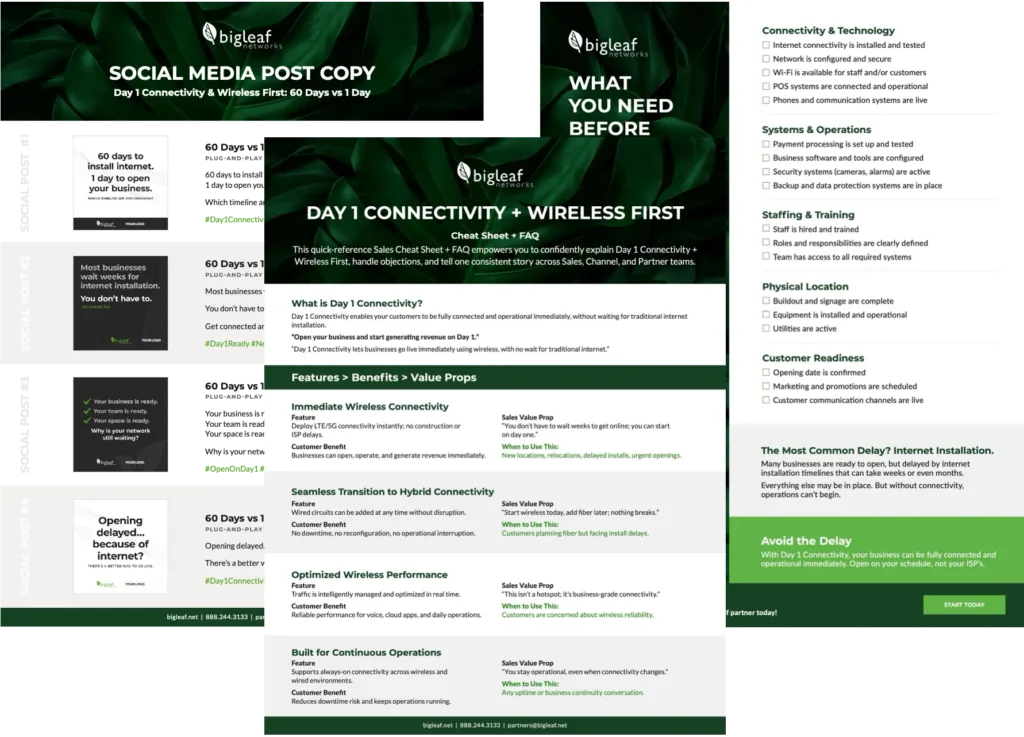
Turn Connectivity Delays into New Revenue Opportunities
Bigleaf’s Day 1 Connectivity Campaign-in-a-Box gives partners everything they need to help customers get online faster, eliminate installation delays, and start operating on day one.
Inside you’ll find co-brandable sales and marketing assets, email campaigns, social content, battlecards, talk tracks, vertical-specific messaging, and a complete deployment guide—all designed to help you create urgency, start meaningful conversations, and close opportunities faster.
Whether you’re supporting new locations, relocations, franchise expansions, or temporary sites, this campaign makes it easy to position Day 1 Connectivity and Wireless Connect with confidence.
See It in Action
Day 1 Connectivity isn’t just about getting customers online faster. It’s about helping them open locations without delays, avoid lost revenue, and deliver a seamless experience from day one.
Whether it’s a new location, relocation, franchise rollout, or temporary site, Bigleaf Day 1 Connectivity combines Wireless Connect and intelligent network optimization to provide immediate connectivity and business-ready performance.
See how partners are using it to create new opportunities in our on-demand webinar:
