

For a business opening a new location, time is always of the essence.
Every day between “ready to open” and “able to operate” has a cost. Staff may already be hired. Equipment may already be installed. Marketing may already be live. Customers may already be expecting service. But if the location is still waiting on internet installation, the business is likely unable to fully operate.
Simply put, that delay affects revenue.
For customers, Day 1 Connectivity helps new locations get online when they are ready to operate. For partners, it creates a stronger way to support customer timelines, accelerate value, and move opportunities forward before connectivity delays become last-minute emergencies.
Connectivity Is a Revenue Dependency
Connectivity is often discussed as infrastructure, but in anymore it’s directly tied to revenue.
Retailers need connectivity to process transactions, manage inventory, support digital signage, enable customer Wi-Fi, and communicate with vendors. Restaurants depend on internet access for payments, online ordering, delivery platforms, reservations, back-office systems, and staff workflows. Healthcare clinics need access to cloud applications, scheduling tools, communication platforms, and patient-facing systems. Construction trailers and temporary offices rely on connectivity to coordinate teams and keep work moving.
When the network is delayed, those systems are delayed.
And when those systems are delayed, revenue is also delayed.
The business may have made every other investment required to open, but without reliable connectivity, those investments cannot fully produce value. A finished buildout does not generate revenue by itself. Staff cannot serve customers effectively without access to the systems they need. Marketing cannot convert demand into sales if the location is not fully operational.
Connectivity is part of the revenue path.
The Traditional Timeline Creates Risk
For many new locations, the traditional process starts with a wired circuit order and ends with a waiting period.
That waiting period can be significant. During a our recent webinar, Ryan Beer, Director of Strategic Partnerships at Bigleaf, noted that internet service provider installation timelines are often “about 30 to 60 days.”
For some businesses, that may fit the plan. For others, it creates a gap between the business timeline and the ISP timeline.
The lease may be signed. The buildout may be done. The opening date may be fixed. But the network may still depend on last-mile availability, permitting, provider scheduling, construction variables, or installation delays outside the customer’s control.
That creates a risky dependency.
If the circuit is ready on time, the business can proceed as planned. If it is not, the customer and partner may be forced to react under pressure.
Day 1 Connectivity changes the timeline.
Instead of waiting for wired service before a location can begin operating, businesses can use wireless connectivity to get online sooner, then add wired circuits later as part of a long-term hybrid network strategy.
Faster Time to Revenue for Customers
For customers, faster time to revenue means removing the connectivity bottleneck from the opening timeline.
A new store does not want to wait to process sales. A restaurant does not want to delay reservations or delivery orders. A clinic does not want to postpone patient-facing operations. A job site does not want teams waiting on cloud access before work can begin.
In each case, connectivity supports the systems that allow the business to operate.
Day 1 Connectivity helps customers:
- Open new locations on schedule
- Begin serving customers sooner
- Start processing transactions faster
- Support employees from the first day
- Avoid revenue delays caused by circuit installation
- Reduce operational uncertainty during launches and relocations
- Add wired service later without waiting to begin operations
That matters because opening a business location involves real financial commitment. Rent, payroll, equipment, systems, inventory, and marketing investments may all begin before the first customer transaction.
The sooner the location can operate, the sooner those investments can begin producing return.
Faster Commission Opportunity for Partners
The revenue impact also matters for partners.
When customer locations get online faster, partners can often move deals forward faster as well. Instead of waiting on wired circuit timelines to complete the deployment, partners can help customers begin operating sooner with a wireless-first approach.
Ryan Beer summarized the partner benefit directly: “What all of that means, for you guys, faster commissions as the partner, which is always a benefit, but also for a customer business, faster time to revenue.”
That dual value is important.
For customers, Day 1 Connectivity supports faster operations.
For partners, it can accelerate service activation, strengthen customer relationships, and create a more proactive sales motion around new locations, relocations, temporary sites, and expansion plans.
It also gives partners a reason to engage earlier in the customer’s planning process. Rather than waiting for an installation delay to create urgency, partners can ask about upcoming openings and timelines before connectivity becomes the blocker.
That shifts the conversation from reactive problem-solving to proactive business planning.
The Partner Conversation Should Start Earlier
Many Day 1 Connectivity opportunities are missed because the conversation happens too late.
By the time a customer learns that a circuit is delayed, the opening date may already be approaching. Staff may already be scheduled. Marketing may already be live. Equipment may already be installed. At that point, everyone is scrambling to solve a problem that could have been anticipated earlier.
Partners can avoid that situation by asking simple questions at the beginning of the customer conversation:
- When is this location expected to open?
- Are you depending on a wired circuit for launch day?
- What happens if the internet installation is delayed?
- Which systems need to be live on day one?
- Do you have new locations, relocations, or temporary sites planned in the next 12 to 24 months?
- How much revenue would be affected if the site opened late?
These questions help uncover the business risk behind the connectivity need.
They also create a more strategic partner conversation. Instead of positioning connectivity as a utility, partners can position it as part of revenue readiness.
That is a stronger conversation.
Reducing Risk Across New Locations
For distributed businesses, one delayed installation is a problem.
But repeated delays across multiple locations can become a growth constraint.
Retail chains, franchises, healthcare groups, restaurants, and service organizations often plan openings across multiple markets. Each site may involve different providers, different infrastructure, different installation timelines, and different levels of local availability.
That variability creates risk.
Day 1 Connectivity can help standardize the launch model. Instead of treating each location as a separate connectivity gamble, businesses can use wireless-first networking as a repeatable way to get locations online faster.
That does not eliminate the need for wired circuits where they make sense. But it does reduce the risk that wired installation delays determine when each location can begin operating.
For customers, that means more predictable launches.
For partners, that means more repeatable deployment conversations.
From Connectivity Delay to Revenue Enablement
The strongest Day 1 Connectivity conversation is not about avoiding inconvenience.
It is about enabling revenue.
When connectivity is delayed, revenue can be delayed. When connectivity is ready on day one, the business can start operating, serving customers, supporting employees, and capturing demand sooner.
That is the shift.
Connectivity should not be treated as something that happens after the business is ready. It should be part of the revenue readiness plan from the beginning.
For partners, this creates a clear opportunity to lead with business value. The conversation is not simply about circuits, routers, or wireless plans. It is about helping the customer avoid lost time and start generating revenue when they are ready.
That is why faster time to revenue starts with faster time to connectivity.
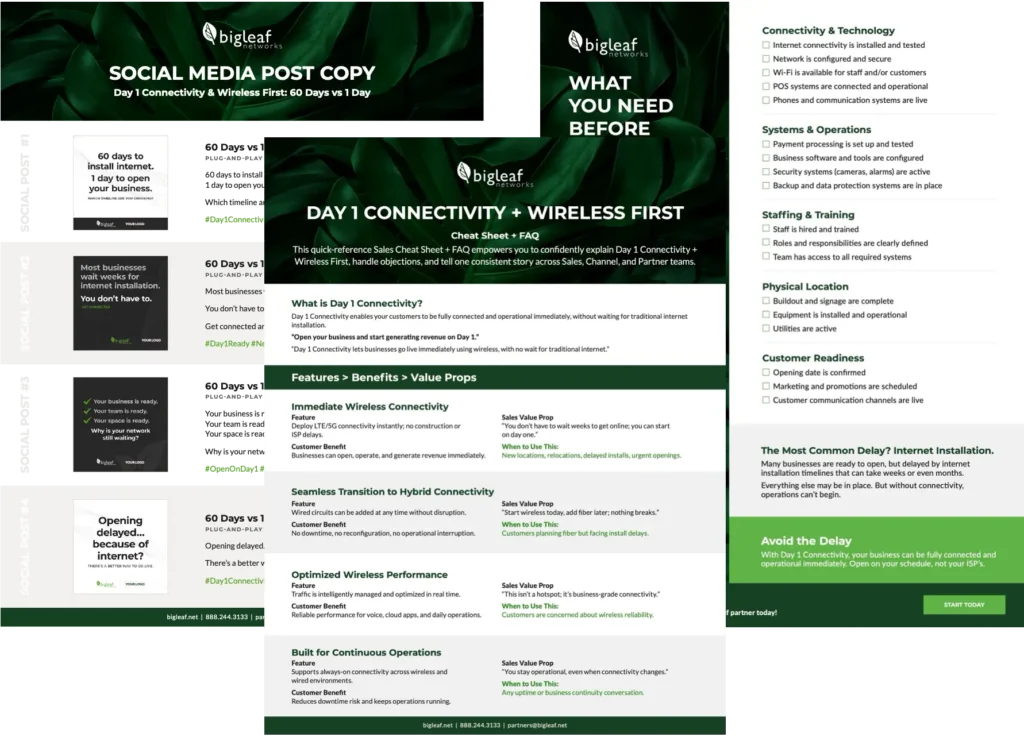
Turn Connectivity Delays into New Revenue Opportunities
Bigleaf’s Day 1 Connectivity Campaign-in-a-Box gives partners everything they need to help customers get online faster, eliminate installation delays, and start operating on day one.
Inside you’ll find co-brandable sales and marketing assets, email campaigns, social content, battlecards, talk tracks, vertical-specific messaging, and a complete deployment guide—all designed to help you create urgency, start meaningful conversations, and close opportunities faster.
Whether you’re supporting new locations, relocations, franchise expansions, or temporary sites, this campaign makes it easy to position Day 1 Connectivity and Wireless Connect with confidence.
See It in Action
Day 1 Connectivity isn’t just about getting customers online faster. It’s about helping them open locations without delays, avoid lost revenue, and deliver a seamless experience from day one.
Whether it’s a new location, relocation, franchise rollout, or temporary site, Bigleaf Day 1 Connectivity combines Wireless Connect and intelligent network optimization to provide immediate connectivity and business-ready performance.
See how partners are using it to create new opportunities in our on-demand webinar:
