
Modern networks are more visible than ever, but seeing the problem isn’t the same as solving it. Dashboards are full. Alerts are constant. Graphs turn red the moment something goes wrong.
And yet, users still experience dropped calls, frozen video, and slow applications.
Because by the time you see the problem… It’s already impacted the business.
This is where, and why, network performance optimization enters the chat.
The Rise of Observability, and Its Limits
Over the past decade, observability has become a cornerstone of IT operations.
Teams can now monitor things like latency, jitter, packet loss, and application performance in real time. This visibility is valuable, and unquestionably helps teams understand what’s happening across increasingly complex, distributed environments.
But visibility alone doesn’t change the outcome.
It simply tells you that something went wrong. But it doesn’t prevent it from happening.
Red Graphs Don’t Protect Revenue
When a performance issue shows up on a dashboard, the impact has already begun.
A call has dropped. A transaction has failed. A user has been disrupted.
And often, the response looks like:
- Open a ticket
- Investigate the issue
- Wait for resolution
Even in well-run environments, this takes time.
Meanwhile, the business absorbs the cost.
And that’s the gap.
Monitoring shows you the problem.
It doesn’t stop the impact.
The Real Cost of Performance Issues
Most performance conversations start with technical metrics.
But the real impact shows up in lost productivity, frustrated employees and team members, poor customer experiences, and missed or delayed revenue.
A lagging CRM slows sales. A dropped call interrupts support. A frozen screen derails a meeting.
Individually, these feel small. At scale, they add up quickly.
That’s why the conversation has to shift.
From:
What happened on the network?
To:
What did it cost the business?
From Reaction to Prevention
The problem isn’t that teams lack visibility. It’s that traditional networks are built to react.
They often rely solely on static configurations, policy-based routing, and failover only after disruption.
Which means action happens after impact.
What’s needed is a different model.
One where performance issues are addressed before users feel them.
Optimization Changes the Outcome
Optimization moves the network from reactive to proactive.
Instead of waiting for a problem to appear, the network continuously:
- Measures real-time conditions
- Identifies degradation early
- Adjusts traffic dynamically
So when conditions change, the network adapts immediately.
Not minutes later. Not after a ticket is opened.
But in the moment.
Optimization doesn’t just show the problem. It prevents it from becoming one.
Why This Matters More Now
As businesses become more dependent on cloud and real-time applications, tolerance for disruption is lessening, or even disappearing.
Voice, video, SaaS platforms, and AI-driven tools all rely on:
- Low latency
- Stable connections
- Persistent sessions
Even brief interruptions can break workflows, disrupt customer interactions, and impact revenue.
And in environments like this, reacting after the fact isn’t enough.
From Insight to Impact
Observability isn’t the problem; it’s incomplete.
It gives you insight. But businesses need impact.
The next step is turning that visibility into action. Automatically, continuously, and in real time.
Where Bigleaf Fits
Bigleaf extends beyond monitoring by actively optimizing network performance as conditions change.
Instead of relying on alerts and manual intervention, it continuously:
- Evaluates latency, jitter, and packet loss
- Routes traffic across the best-performing path
- Preserves active sessions during disruptions
The result isn’t just visibility. It’s consistency.
Applications perform the way they’re supposed to. Users stay productive. Revenue isn’t interrupted.
Visibility Isn’t the Finish Line
Observability was a necessary step forward, but it was never the end goal.
Because the goal isn’t to see problems.
It’s to prevent them.
Turn Network Performance Challenges into Revenue Opportunities
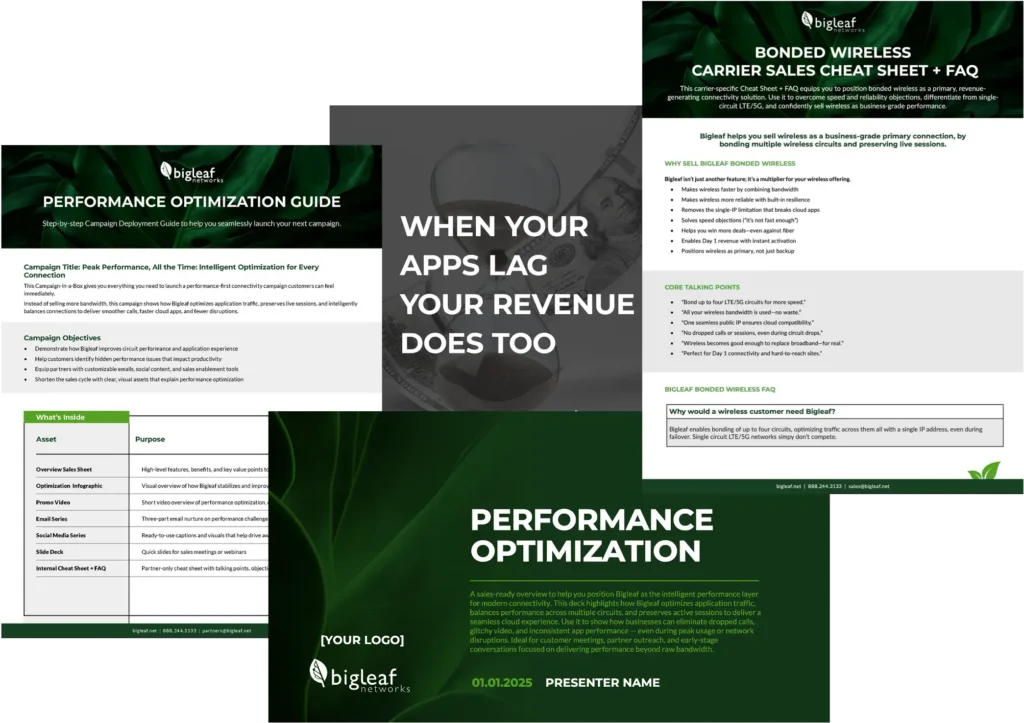
Bigleaf’s Performance Optimization Campaign-in-a-Box gives partners everything they need to shift the conversation from bandwidth to application experience — enabling revenue-focused conversations that drive real business outcomes, including:
Co-branded sales sheets, infographics, and slide decks
A ready-to-deploy webinar kit (title, description, banner, slide deck, and speaker notes)
A multi-touch email series focused on application performance, packet loss, jitter, and real-world user impact
Social posts, companion videos, and industry-specific messaging
A complete deployment guide and recommended 4-week launch timeline
Whether you’re a one-person shop or a full sales team, this campaign equips you to identify performance issues before users feel them, reframe network conversations around business impact, and drive higher-value opportunities — all with less marketing lift.
See It in Action
Network performance isn’t just about staying online.
It’s about helping your customers deliver reliable, business-critical application experiences — by eliminating packet loss, jitter, and instability before users feel the impact.
And when you can lead with performance, you gain the edge to open earlier, more valuable conversations.
To learn more, watch the on-demand webinar: