

Construction trailers, pop-up retail shops, temporary offices, mobile project sites, seasonal operations, and remote locations all have one thing in common: they often need to operate before traditional wired connectivity is available, practical, or sometimes even possible.
Although these locations may be temporary, the work happening there is often mission-critical. Teams need access to cloud applications. Customers need to complete transactions. Project managers need to coordinate crews and vendors. Employees need reliable voice, video, and collaboration tools. Security systems, inventory platforms, payment systems, and operational workflows may all depend on connectivity.
Temporary does not mean unimportant, nor should it mean disconnected.
And that’s why wireless connectivity is playing a new role in how businesses support construction sites, pop-ups, temporary offices, and remote locations. Instead of waiting for traditional wired infrastructure, organizations can use wireless-first networking to get online faster and begin operating when the work is ready to begin.
The New Reality of Temporary Worksites
Temporary locations used to be treated as exceptions. But business operations have changed.
Even temporary environments now rely on cloud-based systems, real-time communication, digital payments, remote collaboration, security tools, and centralized applications. The same platforms that support permanent offices and retail locations often need to support temporary locations as well.
A construction trailer may need access to project management platforms, digital plans, scheduling systems, procurement tools, and video meetings.
A pop-up retail location may need point-of-sale systems, payment processing, inventory access, guest Wi-Fi, staff communications, and cloud applications.
A temporary office may need secure access to business systems, voice services, collaboration platforms, and shared files.
A remote site may need connectivity for field operations, monitoring systems, vendor coordination, and employee productivity.
The location may be temporary. The business requirements are not.
Wired Connectivity Is Not Always Practical
Traditional wired connectivity can be a poor fit for temporary or hard-to-serve environments.
In some cases, the site may not exist long enough to justify a full wired installation. In others, the location may be too remote, too new, or too difficult to reach with standard broadband or fiber. Construction sites may not have permanent infrastructure in place. Pop-up retail locations may need to open quickly. Temporary offices may need to support teams during a move, event, project, or transition.
Sometimes, the business cannot even provide the details a traditional carrier needs to begin the process.
During a recent webinar, Amy Chan, Director of Product Marketing at Bigleaf, explained the challenge clearly: “Construction trailers that are set up that need internet connectivity… in some of these locations, there’s not even a physical address… being able to bring on this wireless connectivity so those construction teams can start getting to work is vital.”
Work happens wherever the project, customer, opportunity, or operation needs to be. Connectivity has to follow.
Wireless Helps Close the Gap
Wireless connectivity gives businesses a faster and more flexible way to support locations where wired service is delayed, impractical, or unavailable.
With LTE, 5G, and other wireless options, organizations can bring sites online without waiting for fiber construction, last-mile availability, or traditional circuit installation. That makes wireless especially valuable for locations that need to move quickly or operate on a limited timeline.
As Ryan Beer, Director of Strategic Partnerships at Bigleaf, noted during the webinar, wireless can support “new, temporary, remote locations,” allowing businesses to be “online… really immediately as soon as that arrives.”
Instead of waiting for infrastructure before work can begin, businesses can deploy wireless connectivity and start operating sooner. For temporary locations, that can be the difference between being productive on day one and losing valuable time to installation delays.
For remote locations, it can be the difference between supporting the operation and leaving teams disconnected.
For pop-up or seasonal businesses, it can be the difference between capturing an opportunity and missing the window entirely.
Business Wireless Requires More Than a Connection
Wireless is powerful, but business environments need more than a basic connection.
A temporary site may need application prioritization, visibility, static IP support, failover, traffic management, and consistent performance across changing network conditions. Voice and video traffic may need to be prioritized. POS systems may need stable connectivity. Cloud applications may need predictable access. Remote users may need secure, consistent sessions.
This is where business-grade wireless differs from consumer-style connectivity.
The objective is not simply to put a wireless circuit in place but rather to make wireless part of a managed, reliable network experience.
With Bigleaf, wireless can be combined with intelligent traffic optimization, dynamic QoS, centralized visibility, and seamless failover when multiple circuits are available. That helps businesses use wireless not just as a temporary patch, but as part of a more flexible network strategy.
Temporary Can Become Strategic
Temporary connectivity is often treated as a short-term fix.
But for many businesses, it can become part of a larger operating strategy.
Organizations are increasingly opening new locations, testing new markets, supporting remote teams, deploying job trailers, using pop-up formats, and operating across distributed environments. In that world, the ability to quickly connect temporary or hard-to-serve locations becomes a competitive advantage.
Wireless-first networking helps businesses move faster.
It gives teams a way to get online when work needs to start, rather than waiting for traditional infrastructure to catch up. It allows partners to support more use cases with less dependency on wired circuit timelines. And it helps customers think differently about where and how they can operate.
Temporary locations are no longer edge cases.
They are an integral part of how businesses grow, adapt, and respond to opportunity.
Turn Connectivity Delays into New Revenue Opportunities
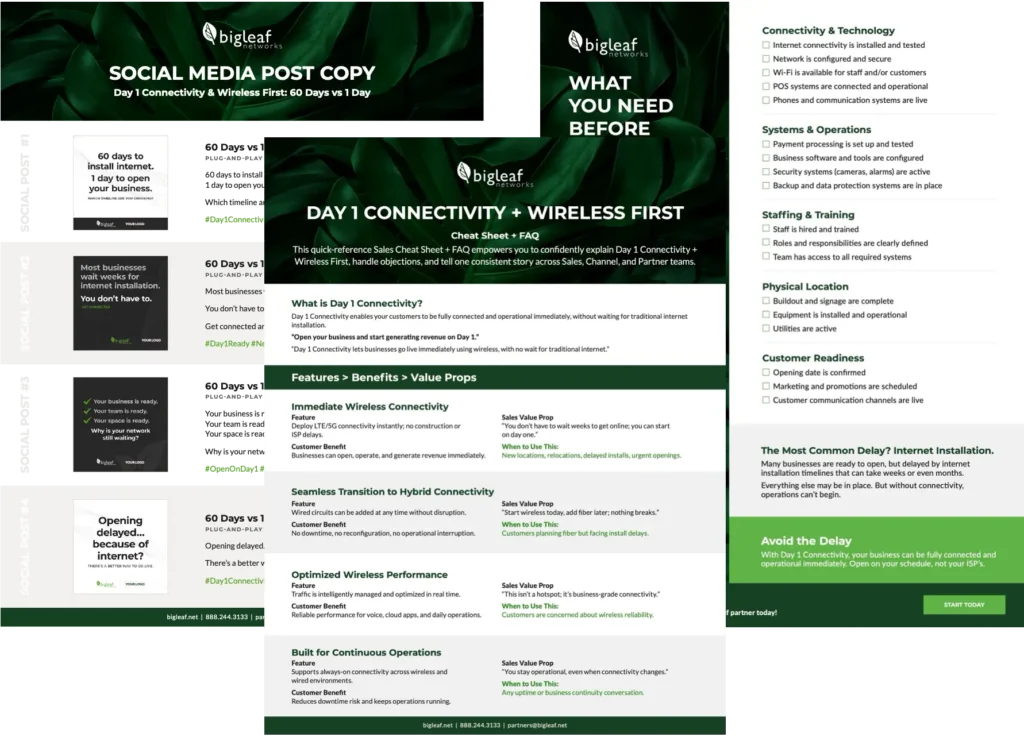
Bigleaf’s Day 1 Connectivity Campaign-in-a-Box gives partners everything they need to help customers get online faster, eliminate installation delays, and start operating on day one.
Inside you’ll find co-brandable sales and marketing assets, email campaigns, social content, battlecards, talk tracks, vertical-specific messaging, and a complete deployment guide—all designed to help you create urgency, start meaningful conversations, and close opportunities faster.
Whether you’re supporting new locations, relocations, franchise expansions, or temporary sites, this campaign makes it easy to position Day 1 Connectivity and Wireless Connect with confidence.
See It in Action
Day 1 Connectivity isn’t just about getting customers online faster. It’s about helping them open locations without delays, avoid lost revenue, and deliver a seamless experience from day one.
Whether it’s a new location, relocation, franchise rollout, or temporary site, Bigleaf Day 1 Connectivity combines Wireless Connect and intelligent network optimization to provide immediate connectivity and business-ready performance.
See how partners are using it to create new opportunities in our on-demand webinar:
