

A new location is almost ready.
The lease is signed. The buildout is complete. Equipment is installed. Staff is hired. The opening date is on the calendar. Marketing campaigns may already be running, and customers may already know when the doors are supposed to open.
Then the call comes. The ISP is delaying the internet installation.
For businesses opening a new location, relocating an office, launching a temporary site, or expanding operations, this scenario is all too familiar. Everything else can be ready, but if connectivity is delayed, the business may simply be unable to open or even operate.
That is why internet installation can no longer be treated as a final checklist item. Connectivity is not just another utility. It is the foundation that enables point-of-sale systems, cloud applications, voice services, security tools, employee workflows, customer interactions, and revenue-generating operations.
When internet installation is delayed, the cost is not just technical.
The Network Is Often the Last Dependency Standing
New location planning involves a long list of moving parts.
Businesses coordinate construction, vendors, staffing, equipment, software, signage, inventory, marketing, and operational readiness. Each of those elements plays a role in whether a location can open successfully.
But connectivity often becomes the last dependency standing.
As Ryan Beer, Director of Strategic Partnerships at Bigleaf, explained during a recent Lunch and Learn webinar, “You’ve hired staff, you’ve installed your equipment, you’re preparing for your opening day… and suddenly something happens that’s delaying your circuit install.”
That delay can quickly become the issue that prevents every other investment from producing value.
A business may have employees ready to work, but no access to the cloud systems they need. It may have registers installed, but no reliable way to process transactions. It may have phones, security systems, inventory platforms, and collaboration tools ready to go, but no stable connection to support them.
The location may be physically ready. But without connectivity, the business simply isn’t operationally ready.
Internet Installation Delays Are Common
Wired internet installations depend on many factors that are outside the control of the business, the IT team, and often even the partner supporting the project:
- Fiber buildouts can take longer than expected.
- Permitting can slow progress.
- Last-mile issues can appear late in the process.
- ISP scheduling can shift.
- Construction timelines can change.
In some cases, the provider may communicate a delay mere days before the expected turn-up date.
For many organizations, this creates a risky assumption: that the wired circuit will be ready exactly when the business needs it.
That assumption does not always hold.
During the same webinar, Beer noted that ISP installation timelines are often “about 30 to 60 days.” Many partners and customers have seen even longer delays depending on the location, provider, construction requirements, and local infrastructure.
For a business on a fixed opening timeline, even a short delay can create real disruption. A circuit that arrives one week late may mean one week of lost revenue, rescheduled operations, frustrated employees, and disappointed customers.
And when that delay happens at the last minute, teams are often forced into reactive problem-solving.
The Cost Is Bigger Than the Circuit
The true cost of a connectivity delay is rarely limited to the circuit itself.
Opening dates may need to move. Staff may be paid before they can fully work. Marketing campaigns may drive customers to a location that is not ready to serve them. Payments, phones, scheduling systems, digital signage, inventory platforms, and customer Wi-Fi may all be affected.
For some businesses, the disruption can start before the first transaction ever takes place.
Beer summarized the impact clearly: “When you look at the revenue delays and impacts that can happen when these circuits aren’t ready, customer impact, the opening dates have to move, customer expectations are not there, their brand suffers.”
That is the hidden cost of waiting for internet installation.
It is not just the delay. It is what the delay prevents.
A retailer may be unable to process purchases. A restaurant may be unable to support ordering systems or payments. A healthcare clinic may be unable to access cloud applications or patient systems. A construction trailer may be unable to coordinate teams and project workflows. A temporary office may be unable to support employees from day one.
In each case, the business impact is larger than a missed installation date.
The network delay becomes a business delay.
Connectivity Delays Also Affect Partners
In general, partners are not responsible for the underlying ISP delay. They rarely control the fiber buildout, installation schedule, permitting process, or last-mile availability. But from the client or customer’s perspective, the partner is often part of the broader technology experience.
That means delays can reflect poorly on the partner, even when the root cause is outside their control.
A customer may not separate the circuit provider from the overall solution. They simply know that the location was supposed to open, the systems were supposed to work, and something failed to come together on time.
That creates unnecessary tension in the relationship.
Partners who address connectivity risk earlier can change the conversation. Instead of reacting to delays after they occur, they can help customers plan for Day 1 readiness from the beginning. That positions the partner as a strategic advisor, not just someone trying to solve a last-minute problem.
The opportunity is not only to provide connectivity, but to protect the customer’s opening timeline.
The Old Model Leaves Too Much to Chance
The traditional connectivity model for a new location is straightforward:
Sign the lease. Build out the location. Order the wired circuit. Wait for installation. Hope everything is ready before opening day.
That model may work when timelines are flexible and installation goes according to plan. But for many businesses, opening dates are not flexible. Staffing, marketing, construction, inventory, customer commitments, and revenue expectations all depend on the business being able to operate on schedule.
When the entire opening plan depends on one wired circuit being installed on time, the business is exposed to unnecessary risk.
The problem is not wired connectivity itself. Wired circuits are still valuable and often remain part of the long-term network strategy. The problem is relying on a wired circuit as the only path to operational readiness.
If the circuit is delayed, the business is delayed.
That is the gap Day 1 Connectivity is designed to close.
Wireless Changes the Timeline
Wireless connectivity has changed what is possible for new locations, relocations, temporary sites, and remote operations.
With modern LTE and 5G options, businesses no longer have to wait for traditional wired infrastructure before they can get online. Wireless can help locations begin operating sooner, even when fiber, broadband, or other wired circuits are still pending.
This is especially important for businesses that cannot afford to let connectivity determine their launch timeline.
A wireless-first approach does not necessarily mean wireless-only forever. A location can certainly start with wireless to support immediate operations, then add wired circuits later as part of a hybrid network strategy.
The important part is that the business no longer has to wait.
Instead of asking whether the wired circuit will arrive before opening day, businesses and partners can ask a better question:
How do we make sure this location is operational when the business is ready?
That is the foundation of Day 1 Connectivity.
Turn Connectivity Delays into New Revenue Opportunities
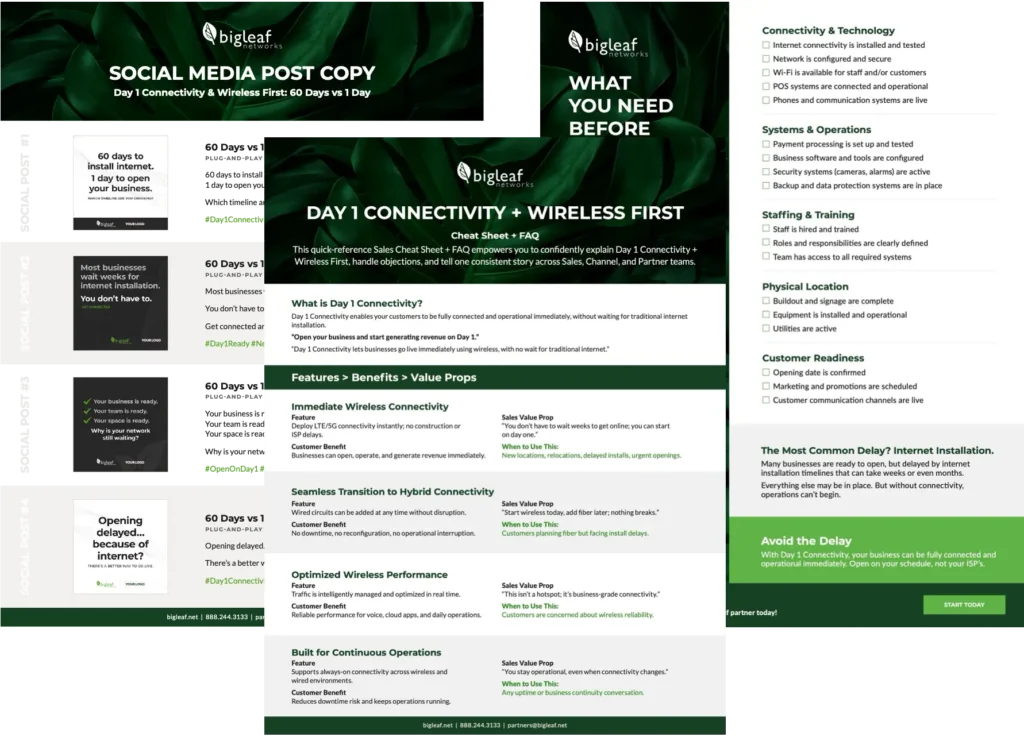
Bigleaf’s Day 1 Connectivity Campaign-in-a-Box gives partners everything they need to help customers get online faster, eliminate installation delays, and start operating on day one.
Inside you’ll find co-brandable sales and marketing assets, email campaigns, social content, battlecards, talk tracks, vertical-specific messaging, and a complete deployment guide—all designed to help you create urgency, start meaningful conversations, and close opportunities faster.
Whether you’re supporting new locations, relocations, franchise expansions, or temporary sites, this campaign makes it easy to position Day 1 Connectivity and Wireless Connect with confidence.
See It in Action
Day 1 Connectivity isn’t just about getting customers online faster. It’s about helping them open locations without delays, avoid lost revenue, and deliver a seamless experience from day one.
Whether it’s a new location, relocation, franchise rollout, or temporary site, Bigleaf Day 1 Connectivity combines Wireless Connect and intelligent network optimization to provide immediate connectivity and business-ready performance.
See how partners are using it to create new opportunities in our on-demand webinar:
