

Wireless connectivity just ain’t what it used to be; it’s so much more.
LTE and 5G are now widely available. Speeds have improved. Coverage has expanded. Data plans have become more flexible. And for many businesses, wireless now plays an important role in supporting new locations, temporary sites, remote offices, construction trailers, and rapid deployments.
But signal strength alone does not make wireless business-grade.
A strong wireless signal may get a location online. It may provide bandwidth. It may give teams access to the internet. But business operations require more than basic connectivity; they require application performance. We’re talking session continuity, static IP support, traffic prioritization, network visibility, seamless failover, cost control, and the ability to support critical systems without forcing teams to manage every detail manually.
That’s why business wireless needs more than a connection.
Wireless Is No Longer Just a Backup Option
In days past, many organizations understandably thought of wireless as merely a backup or contingency plan.
But anymore, businesses are increasingly using LTE and 5G to support Day 1 Connectivity, temporary locations, remote sites, and even primary connectivity scenarios. Wireless can help organizations get online faster, avoid waiting on wired circuit installation, and support operations in places where traditional infrastructure is delayed, impractical, or unavailable.
As Amy Chan, Director of Product Marketing at Bigleaf, explained during our recent webinar, “These are not just hotspots that we are plugging in. These are full-fledged LTE 5G connections that can work as your primary line.”
That distinction matters because while a hotspot may provide access, a business-grade wireless strategy supports operations.
The difference is what happens around the connection.
The Problem with Treating Wireless Like Ordinary Internet
Wireless can provide a path to connectivity, but business environments place very specific demands on the network.
A location may need to support:
- Point-of-sale systems
- Voice and video calls
- Cloud applications
- Security tools
- Payment platforms
- Guest Wi-Fi
- Inventory systems
- Remote access
- Vendor connections
- Back-office applications
Each of these systems may have different performance requirements. Some are sensitive to latency or jitter. Some require stable sessions. Some depend on predictable IP identity. Some need to be prioritized over less critical traffic.
When wireless is treated like ordinary internet access, those needs can be overlooked.
The result may be a connection that works in theory but struggles in practice. Voice quality may suffer. Video calls may freeze. POS systems may become unreliable. Applications may slow down. Users may blame the wireless connection when the real issue is lack of traffic management, visibility, or continuity.
QoS Matters for Critical Applications
One of the most important requirements for business wireless is traffic prioritization.
Because not all traffic is equal.
A voice call should not compete with a large file download. A POS transaction should not be treated the same as guest Wi-Fi traffic. A video meeting, payment system, or cloud application may require more consistent performance than background traffic.
In many traditional wireless environments, those priorities are difficult to manage manually. Customers and partners may worry that voice, video, or business-critical applications will not perform reliably over LTE or 5G.
That is where dynamic QoS becomes important.
Ryan Beer, Director of Strategic Partnerships at Bigleaf, explained the value clearly: “That dynamic automated QoS means that the customer, or you as the partner, are not having to set manual QoS rules over that wireless circuit.”
This matters because business wireless should not require every customer or partner to become a traffic engineering expert.
Automated QoS helps prioritize critical applications out of the box, so the systems that matter most receive the treatment they need across the wireless connection.
That makes wireless more practical for real business use.
Visibility Turns Wireless Into Something Manageable
Another key difference between basic wireless access and business-grade wireless is visibility.
Businesses need to understand how circuits are performing. They need to know whether issues are related to latency, packet loss, congestion, signal quality, circuit health, or provider performance. Without visibility, troubleshooting becomes guesswork.
That can be especially challenging with wireless.
If users report poor application performance, teams need to know whether the issue is with the wireless circuit, the application, the device, the carrier, or another part of the network path. Without the right data, teams may waste time escalating to providers, swapping hardware, adding bandwidth, or making changes that do not solve the problem.
Business wireless needs centralized visibility into circuit performance and network behavior.
That visibility helps teams troubleshoot faster, make better decisions, and understand whether wireless is performing the way the business requires.
It also gives partners a stronger way to support customers. Instead of relying on assumptions or carrier reports alone, they can look at actual performance data and help customers understand what is happening.
Static IP Support Can Determine Whether Wireless Works
For many businesses, wireless connectivity is not useful unless it can support the systems and services already built around static IP requirements.
Some applications, vendors, payment systems, security tools, remote access workflows, and compliance environments depend on stable public IP identity. They may require IP-based allowlisting, inbound access, segmentation, VPN access, or other services that assume a predictable address.
That can create a challenge with wireless.
As Amy noted during the webinar, “Most wireless carriers can only provide one static IP address, which doesn’t support… a lot of the services and solutions that require wireless connectivity.”
That limitation can prevent wireless from being used effectively in business environments that need more than basic internet access.
A retailer may need separate IP identities for POS, surveillance, vendor systems, and corporate access. A healthcare organization may need segmentation for regulated applications. A branch office may need stable addressing for VPN or hosted services. A construction site may need secure access to cloud tools and partner platforms.
If wireless cannot support those requirements, it may be disqualified before it ever has a chance to solve the connectivity problem.
Failover Must Preserve More Than Connectivity
Redundancy is often discussed in terms of staying online. But for many business applications, simply staying connected is not enough. If a circuit fails and traffic moves to another path, applications may still experience disruption if the IP address changes, sessions reset, or users have to reconnect.
From the user’s perspective, that still feels like downtime. Traditional failover may restore connectivity, but it does not always preserve continuity.
Business wireless needs failover that protects the user experience. That means maintaining session continuity wherever possible and helping applications keep working even as traffic shifts between available circuits.
This is especially important in hybrid environments where wireless may work alongside fiber, broadband, satellite, or other connection types. The value is not just having another circuit available. The value is being able to move traffic across those circuits without unnecessary disruption.
How Bigleaf Makes Wireless Business-Grade
Bigleaf helps businesses use wireless more effectively by pairing LTE and 5G connectivity with the network intelligence needed for real operations.
With Bigleaf, wireless can be supported by dynamic QoS, application-aware prioritization, centralized visibility, intelligent traffic management, static IP options, and failover capabilities that help preserve sessions and keep work moving.
Instead of being a simple connection, wireless becomes part of an optimized connectivity strategy. It can support immediate deployment, business-critical applications, hybrid network designs, and continuity across changing conditions.
For customers, that means more confidence in using wireless for new locations, temporary sites, remote offices, or rapid deployments.
For partners, it creates a stronger conversation around outcomes. The value is not simply that wireless is available. The value is that wireless can be made reliable, visible, and aligned to the way the business actually operates.
Signal Strength Is Only the Starting Point
Wireless has moved well beyond its old role as a last-resort backup option.
LTE and 5G can help businesses get online faster, avoid installation delays, support remote or temporary locations, and operate from day one.
But signal strength alone is not enough.
Business wireless needs prioritization. It needs visibility. It needs static IP support. It needs failover that protects sessions. It needs the ability to support critical applications in real-world conditions.
That is what turns wireless from a connection into a business-grade network experience.
And for organizations looking to move faster, open sooner, and operate with more confidence, that difference matters.
Because the goal is not simply to get online.
The goal is to keep the business working.
Turn Connectivity Delays into New Revenue Opportunities
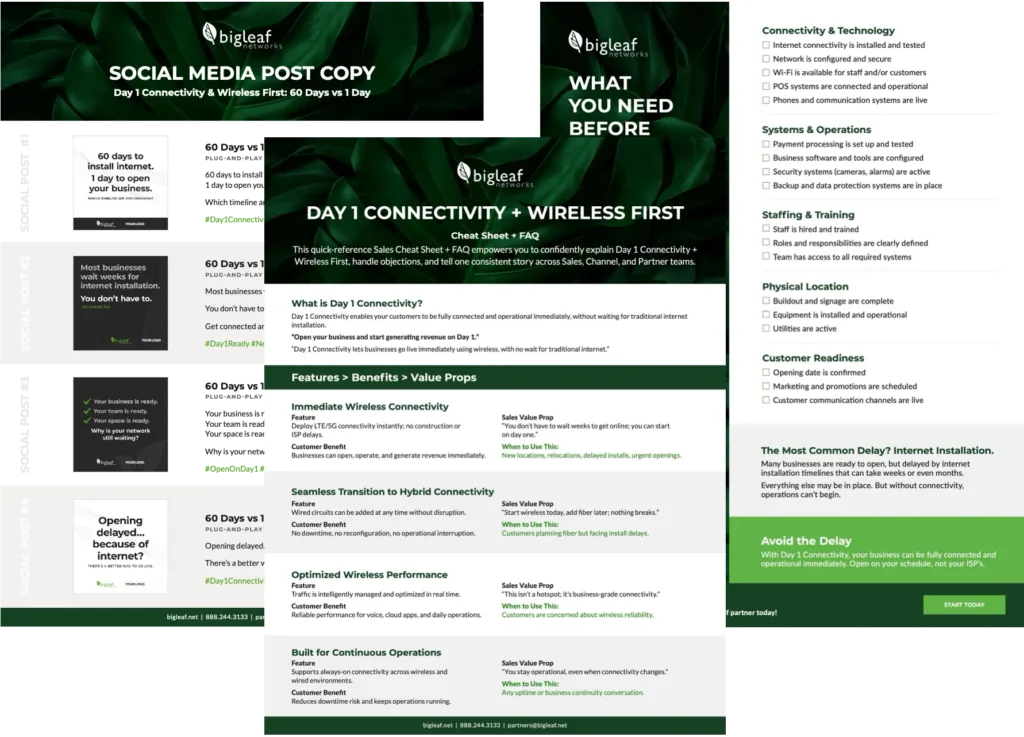
Bigleaf’s Day 1 Connectivity Campaign-in-a-Box gives partners everything they need to help customers get online faster, eliminate installation delays, and start operating on day one.
Inside you’ll find co-brandable sales and marketing assets, email campaigns, social content, battlecards, talk tracks, vertical-specific messaging, and a complete deployment guide—all designed to help you create urgency, start meaningful conversations, and close opportunities faster.
Whether you’re supporting new locations, relocations, franchise expansions, or temporary sites, this campaign makes it easy to position Day 1 Connectivity and Wireless Connect with confidence.
See It in Action
Day 1 Connectivity isn’t just about getting customers online faster. It’s about helping them open locations without delays, avoid lost revenue, and deliver a seamless experience from day one.
Whether it’s a new location, relocation, franchise rollout, or temporary site, Bigleaf Day 1 Connectivity combines Wireless Connect and intelligent network optimization to provide immediate connectivity and business-ready performance.
See how partners are using it to create new opportunities in our on-demand webinar:
