
SD-WAN FEATURES
A Smarter Kind of Internet Connectivity Solution
If your business uses the internet, make sure to use Bigleaf

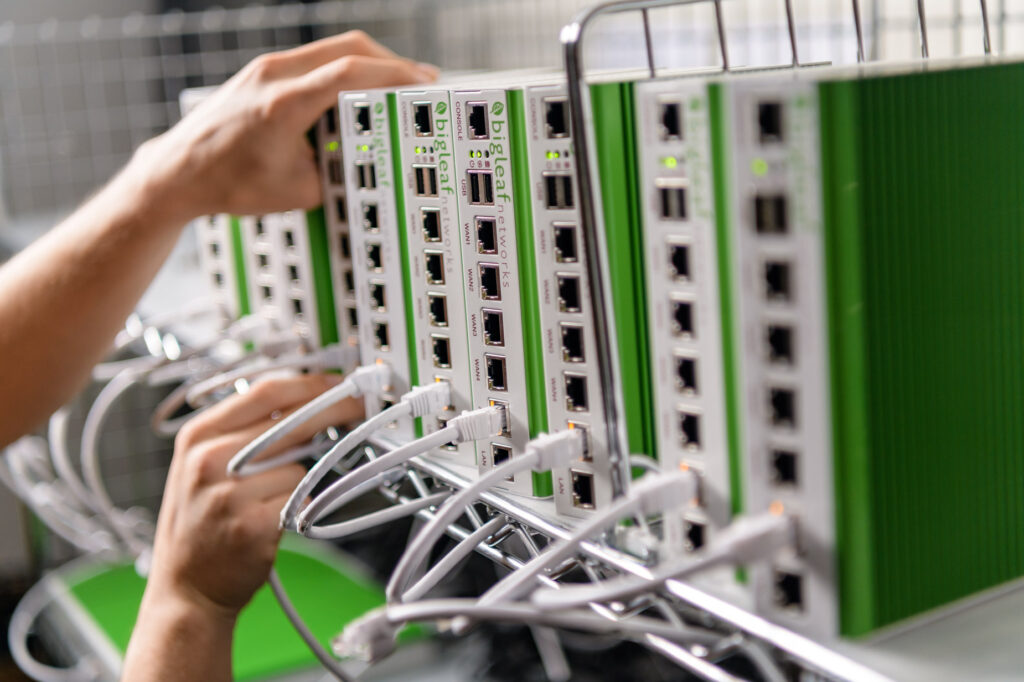
Meet the Bigleaf Router
Your gateway to an internet without downtime
- Arrives pre-configured with your circuit details for 90-second plug-and-play installation
- Installs outside of your firewall and works with any existing network infrastructure
- Connects up to four broadband circuits
- Connects your business to our backbone Cloud Access Network with a Bigleaf-issued IP block
Intelligent Software for Unrivaled Connectivity
Resiliency and redundancy through automatic internet optimizations
Dynamic QoS
Automatically classifies and prioritizes all traffic
Ensure your business critical applications work reliably and optimally with Bigleaf’s Dynamic QoS. Bigleaf detects and identifies your traffic types in real time without manual policies, then applies QoS policies based on circuit throughput, effortlessly providing enterprise-grade QoS.
Circuit Monitoring
Tracks circuit performance in real time
Bigleaf monitors each of your internet connections through to our gateway clusters for end-to-end diagnostics and visibility. Critical metrics such as latency, jitter, packet loss, and capacity are measured 10 times per second in both directions to determine how traffic should be routed for optimal application performance.
Intelligent Load Balancing
Gives each traffic type the resources it deserves
Bigleaf intelligently prioritizes and routes your traffic across circuits for smooth, uninterrupted connectivity. Voice and video calls are automatically routed to the circuit with the lowest latency, jitter, and packet loss, while high-throughput tasks are directed to the circuit with the most available bandwidth.
Same IP Address Failover
Eliminates downtime from ISP outages
Outage-proof your connection with Bigleaf-issued IP addresses that don’t change when traffic shifts between ISP circuits. Nearby cable cuts, routing issues, and network instability no longer cause downtime or slowdowns as failover is seamless and automatic and goes unnoticed by your applications.
Built on the Bigleaf Cloud Access Network
Your gateway to an internet without downtime
- 12 points of presence (POPs) for reliable connectivity across the United States and Western Europe
- Redundancy built into every part of our network with multiple core routers, servers, transit circuits, and more
- Peering with 150+ cloud, content, and carrier networks for private, direct connections with cloud applications


Bigleaf is easy to use, and is mostly automatic. But some things need a human touch.
For those rare moments your IT team needs another pair of eyes on a problem or troubleshoot, our customer support experts are here to support you.
See what other customers and partners have to say about Bigleaf’s Support Team
The Best of Everything, in One Easy-to-Use Service
Bigleaf is the trusted partner of thousands of businesses for a reason
| Bigleaf | Dual-WAN firewalls | Carrier-based SD-WANs | |
|---|---|---|---|
| Owned and operated Cloud Access Network | |||
| End-to-end traffic management | |||
| Same-IP failover | |||
| Carrier- and firewall-agnostic | |||
| Real-time circuit visibility | |||
| Turnkey deployment; no manual policies needed |

Remarkably dependable network connectivity begins with Bigleaf.
Subscribe on LinkedIn to the Bigleaf Bytes Newsletter
Does Bigleaf maintain active sessions during internet failover?
Bigleaf maintains active sessions during internet failover through same-IP failover. Because 100% of customer traffic is tunneled to Bigleaf’s gateway clusters before reaching the internet, the public IP is issued from Bigleaf’s infrastructure — not from any ISP. When a circuit fails or degrades, Bigleaf reroutes traffic to the best-performing available circuit, but the public IP never changes. Active VoIP calls, VPN tunnels, and cloud app connections remain uninterrupted. Users don’t notice the switch happened. This works for every application, out of the box, without policy configuration.
When should I choose Bigleaf instead of a traditional dual-WAN router?
A dual-WAN router controls traffic only at the customer edge and uses ISP-assigned IPs, so failover always changes the IP and drops sessions. Bigleaf’s Cloud Access Network extends control from the customer site to the internet core, and the public IP is issued from Bigleaf’s infrastructure independent of any ISP. This is the structural difference: Bigleaf provides same-IP failover out of the box for every application without policy configuration. Per the Evaluating Bigleaf PDF: ‘Many vendors who claim to have this require policy configuration to get it set up.’ Bigleaf does not.
Can Bigleaf optimize multiple internet providers simultaneously?
Bigleaf monitors up to four internet circuits at once, measuring latency, packet loss, and jitter on each 10 times per second in both directions. Per-flow load balancing sends each data flow to the best-performing circuit based on real-time quality, not just capacity, round-robin, or primary/backup. If a circuit drops below application performance thresholds, Bigleaf automatically reroutes affected flows to a healthier one. Dynamic QoS works across all active circuits, prioritizing real-time traffic over bulk transfers on any circuit. Same-IP failover keeps the public IP unchanged when a flow moves between circuits, so active sessions survive. Bigleaf works with any mix of circuit types, including fiber, cable, LTE, 5G, Starlink, and fixed wireless.
How does Bigleaf compare to other SD-WAN vendors?
Bigleaf competes in the SD-WAN and internet optimization category but differentiates on three capabilities most competitors lack: same-IP failover (sessions never drop during circuit switches), automated Dynamic QoS enforced end-to-end through the Cloud Access Network (not just at the router), and plug-and-play deployment outside the firewall with no policy configuration required. These are not feature additions, they are architectural outcomes of Bigleaf’s split architecture (on-premises router + Cloud Access Network gateway clusters).
How does Bigleaf improve application performance?
Bigleaf improves application performance with three mechanisms that work together:
- Continuous circuit monitoring: Bigleaf measures latency, packet loss, and jitter 10 times per second in both directions, catching degradation short of a full outage before users notice.
- Per-flow load balancing: Each data flow is steered to the best-performing circuit based on real-time quality, not just capacity.
- Bi-directional Dynamic QoS: Real-time traffic like VoIP and video is prioritized over bulk transfers, and that priority is enforced end to end through the Cloud Access Network, not just at the router edge.
What makes Bigleaf different from traditional SD-WAN solutions?
Bigleaf uses a split architecture: an on-premises router plus a dedicated Cloud Access Network of gateway clusters built into major internet peering hubs. Traffic is tunneled end-to-end, giving Bigleaf bi-directional QoS enforcement and full-path visibility. Same-IP failover is automatic: the public IP is issued from Bigleaf’s infrastructure, not the ISP, so sessions never drop. No manual policies required. Installs outside the firewall with no security changes needed.