
Why Tomorrow’s Technology Decisions Start Today
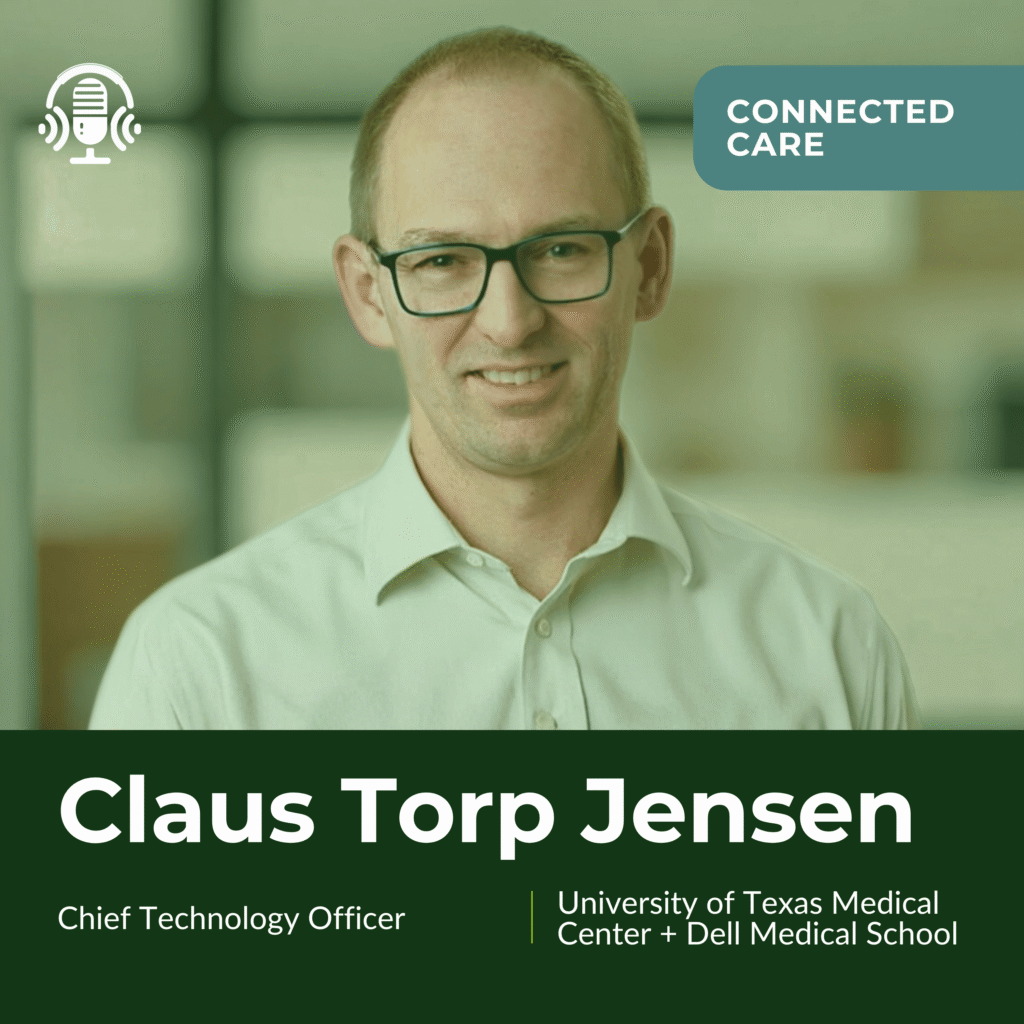
How do you build technology that still works a decade or more from now? According to Claus Torp Jensen, Chief Technology Officer at the University of Texas Medical Center and Dell Medical School, the answer is not better short-term optimization. It is future backwards thinking.
Rather than starting with today’s constraints and iterating forward, future backwards thinking asks leaders to define a clear long-term destination and then engineer backward from that point. For CTOs responsible for infrastructure, networks, and long-lived facilities, this shift fundamentally reframes how roadmaps, budgets, and standards are set. The goal is not prediction. The goal is preparation.
Claus is overseeing the construction of a next-generation academic medical center where his team has already catalogued more than 30 design decisions shaped by asking what 2040 will require — and what must be built today to get there. The result is a planning discipline that any technology leader can apply, regardless of industry.
Designing Environments That Can Evolve With Care
When leaders plan from the future, design assumptions change. Claus shares how imagining healthcare delivery in 2040 leads to concrete decisions today: wider corridors that allow people and robots to move together without dedicated lanes, production labs that support individualized therapies at the point of care, and patient lounges that replace traditional waiting rooms with functional spaces for onboarding, wearable pickup, and supervised waiting.
These choices are not about locking in specific technologies. They are about building capacity and flexibility so new workflows and tools can emerge without forcing constant rebuilds. By planning for how care will likely be delivered, organizations avoid opening facilities that are already outdated on day one — a pattern Claus says is far more common than it should be.
When the Network Becomes a Safety System
As healthcare grows more sensor-driven and software-defined, connectivity moves from a utility to a clinical safeguard. Tens of thousands of sensors, paired with edge computing, depend on uninterrupted network performance. Remote surgical presence and real-time monitoring create conditions where a network failure is not just a business disruption — it is a patient risk.
Future backwards thinking pushes CTOs to design networks with diversified redundancy across wired and wireless paths, test failovers under real-world load, and treat uptime as a patient-facing metric. Claus makes the case plainly: the network is not a technology construct. It is the business. That framing changes every governance, budgeting, and design conversation that follows.
Aligning Technology With People and Purpose
Long-horizon strategies succeed only when people stay aligned over years of change. Claus names storytelling as the leadership discipline that keeps teams focused on outcomes rather than tools. Knowing who your chief storytellers are — and giving them the space to connect daily work to a shared future destination — is what sustains culture and momentum through the marathon of transformation, not just a sprint.
The “what box” mindset Claus describes is the practical expression of this: instead of thinking inside or outside the box, he asks whether the box itself is even the right frame. That question frees teams from assumptions rooted in today’s limitations and opens the conversation to what the future actually requires.
EPISODE HIGHLIGHTS
- Defining a 2040 destination before setting any near-term roadmap
- Designing facilities and networks for adaptability, not fixed workflows
- Treating connectivity as a mission-critical safety system, not a utility
- Building sensor-dense environments with edge computing to filter signal from noise
- Using storytelling and people leadership to sustain long-horizon transformation
Watch the full episode on YouTube to hear the complete conversation, then explore the related articles and short-form videos that go deeper on each theme. Subscribe to Go Beyond the Connection for more conversations with leaders building for resilience, performance, and human impact.