
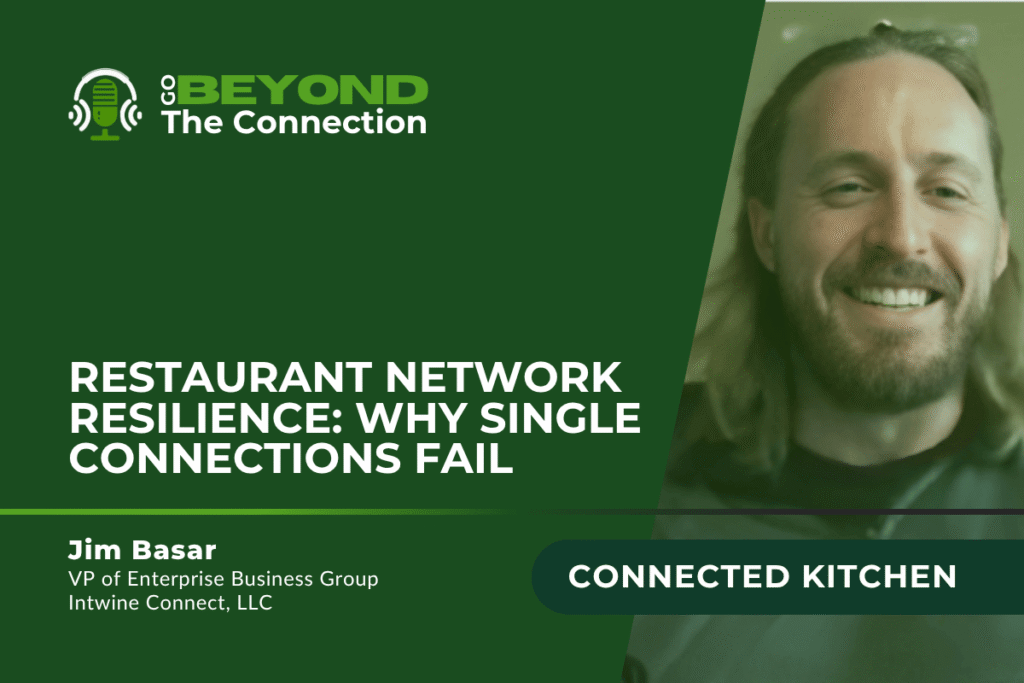
The most dangerous assumption a restaurant operator can make today is that internet connectivity is a commodity — something you buy from whoever offers the cheapest monthly rate and forget about. That assumption made some sense a decade ago. It makes almost none today. The shift to cloud-based point-of-sale systems, connected kitchen equipment, AI-powered drive-throughs, and third-party delivery integrations has turned the network into the circulatory system of the modern restaurant. When it fails, the body stops.
Jim Basar has spent the last fifteen years watching this transition unfold from the inside. As VP of Enterprise Business Group at Intwine Connect, LLC, he works with large franchise organizations and QSR chains to design and support the connectivity infrastructure their locations depend on. His background in engineering and IoT systems development means he is not just selling connectivity. He is building it, maintaining it, and debugging it when something goes wrong at 2 a.m. in a location three time zones away.
The Single Point of Failure Problem
Most restaurant locations still rely on a single broadband connection. That was an acceptable risk when the internet supported peripheral tasks. It is a serious operational liability now. Cloud POS systems require continuous access. Temperature sensors need to communicate in real time. Online orders arrive through the network. A single cable cut, a carrier outage, or a congested cell tower during peak hours can freeze every one of those systems simultaneously.
Jim describes the data explosion that makes this problem more urgent. One franchise chain he works with saw monthly data consumption rise from 30 gigabytes to over 1.2 terabytes after upgrading to a more capable cloud POS platform. That same expansion is happening across the industry. More data means more pressure on whatever connection is in place. Single-connection architectures that were marginal before are now genuinely inadequate.
What Network Resilience Actually Looks Like
People often use the term resilience loosely in technology discussions, but Jim defines it in practical terms. Resilient connectivity ensures that when one connection path degrades or fails, another immediately takes over without the kitchen crew or the customer noticing. Operators achieve this by bonding a wired broadband connection with a 4G or 5G cellular backup, adding a Starlink satellite path where terrestrial options are limited, or using an SD-WAN layer to intelligently distribute traffic across those combined paths based on performance and availability.
“We’ve created resiliency in that network by utilizing multiple technologies at a cost-effective rate. It’s not that you have to bet your entire business on one connection. There are plenty of options where we could still give you resiliency and five nines of reliability.” — Jim Basar
Franchise networks that operate hundreds or thousands of locations across every type of market—dense urban, suburban, rural, and everything in between—cannot treat flexibility as optional. National brands cannot afford to let small-town locations drop offline because they relied only on fixed broadband. Today’s cellular and satellite landscape gives operators viable primary options, allowing them to build wireless-first or wireless-plus-wired strategies instead of relying on them as fallback plans.
Proactive Monitoring Changes the Equation
The second half of the resilience conversation is not about infrastructure. It is about visibility. Building a redundant network only gets you partway. You also need to know what is happening on that network before your team manager calls you with a complaint. Jim’s engineering team at Intwine Connect applies condition-based monitoring principles developed in industrial IoT contexts to the restaurant network space.
The approach involves tracking leading indicators rather than waiting for failure alerts. Signal strength trends, latency spikes, device behavior anomalies — these are the canaries in the coal mine. When the system identifies a pattern suggesting a connection is heading toward a problem, the team can intervene before operations are affected. Jim extends the same principle to IoT temperature sensors in restaurant coolers and freezers, where predictive algorithms eliminated over 90 percent of false positive alerts while catching every legitimate issue.
The Practical Takeaway for Operators
For restaurant operators and IT leaders evaluating their connectivity strategy, Jim’s conversation offers a clear framework. Start with an honest audit of what the network currently carries, and ask whether a single-connection architecture can realistically support that load reliably. Evaluate where locations are exposed to single points of failure. Consider hybrid approaches that combine wired and wireless options. And look for partners who bring proactive monitoring and context-aware support, not just hardware installation.
The operators who treat connectivity as a strategic infrastructure investment rather than a commodity line item will find themselves better positioned to absorb the next wave of technology adoption, whether that is AI-powered drive-throughs, expanded delivery integrations, or the next generation of kitchen automation. The ones who wait for a failure to prompt a change will keep paying for it in lost revenue, damaged customer impressions, and operational disruption that was entirely preventable.
SUBSCRIBE & LISTEN >
Related Links:
- Simplifying Your Technology Stack
- How the Connected Kitchen Powers the Modern Enterprise
- Restaurant Technology Transformation: How the Connected Kitchen Drives Growth
- Survival to thrival: Unexpected ways new flavor has been added to the restaurant experience
- 10 reasons why restaurant operators are hungry for better internet health
- Why Restaurant Operators Can No Longer Afford to Ignore Network Resilience
- The Connected Kitchen: Restaurants Are Now Technology Companies
Related Episodes:
Related Links:
- [Primary Episode Page Link]
- [Related Blog Article 1]
- [Related Blog Article 2]
- [YouTube Playlist]
- [YouTube Shorts Playlist]
- [LinkedIn Newsletter]
- [Captivate Podcast Link]