

For years, wireless connectivity was treated as a backup plan.
If the primary circuit failed, LTE could keep the business online. If a wired installation was delayed, wireless could serve as a temporary bridge. If a site needed a short-term workaround, wireless could fill the gap until the “real” connection arrived.
That model made sense when wireless was slower, less available, and less trusted for business-critical operations.
Today, LTE and 5G are widely available, increasingly capable, and far more practical for business use than they were just a few short years ago. At the same time, businesses are opening new locations faster, operating in more distributed environments, and relying on cloud applications that need consistent performance from day one.
As a result, wireless is becoming a strategic part of how businesses get connected, stay connected, and launch new locations without waiting on traditional wired circuit timelines.
Wireless First Is a Mindset Shift
Wireless-first networking does not mean every business should abandon wired connectivity.
Fiber, broadband, and other wired circuits still play an important role in many network environments. For many businesses, the long-term network strategy will include a combination of wired and wireless connectivity working together (aka. “hybrid” connectivity).
Instead of treating wireless as the emergency option after a wired circuit is delayed, businesses can lead with wireless to get locations online sooner. Wired circuits can still be added later, but they no longer have to determine when the location can begin operating.
As Ryan Beer, Director of Strategic Partnerships at Bigleaf, explained during our recent Lunch and Learn webinar, “I think the difference here is thinking about leading with wireless in a lot of these opportunities is maybe a little bit of a mind shift.”
For new locations, relocations, construction trailers, temporary offices, pop-up retail, and remote sites, waiting for wired connectivity can create unnecessary delays. Wireless-first networking gives businesses another path: start operating now, then expand the network as additional circuits become available.
The Old Wireless Assumption Is Outdated
Many businesses still think of wireless as limited, temporary, or best used only when something else fails.
That assumption is increasingly outdated.
Modern LTE and 5G services can support a wide range of business operations, especially when combined with intelligent networking capabilities such as SD-WAN, automated QoS, application prioritization, static IP support, and seamless failover.
The real question is no longer whether wireless can be used for business connectivity, but how should wireless be integrated into the network so it can support business operations reliably?
A single wireless circuit without traffic prioritization, visibility, or failover may not indefinitely meet the needs of a modern business location. But when wireless is part of an intelligent connectivity strategy, it becomes far more powerful.
That is where wireless-first becomes different from wireless-only.
Why Businesses Are Leading with Wireless
Businesses are increasingly leading with wireless because traditional installation timelines simply don’t always match operational timelines.
A location may be ready to open before a wired circuit is installed. A construction site may need connectivity before permanent infrastructure exists. A temporary office may need to support employees immediately. A pop-up location may not justify a traditional circuit installation at all.
In these environments, wireless provides flexibility.
It can help businesses:
- Get online faster
- Avoid opening delays
- Support temporary or remote sites
- Reduce dependency on wired circuit timelines
- Begin operations while waiting for fiber or broadband
- Add wired circuits later as part of a hybrid strategy
This is especially important for organizations with fixed launch dates. If a store, restaurant, clinic, office, or job site is ready to operate, connectivity should not be the reason it has to wait.
Beer summarized the opportunity this way: “It’s not to say that site can’t still use some sort of hard line circuit… but in terms of not having to risk the open date… wireless is ready to go.”
That is the core value of leading with wireless.
The business can start when the business is ready.
Wireless First Supports Day 1 Connectivity
Wireless-first networking is one of the key enablers of Day 1 Connectivity.
Day 1 Connectivity means a business location can get online when it is ready to operate, instead of waiting on traditional wired circuit installation. Wireless helps make that possible by providing a faster path to connectivity.
This matters because wired circuit installation can take weeks. Timelines can shift. Providers can encounter last-mile issues, permitting delays, construction complications, or scheduling changes.
When wireless is available as part of the launch strategy, businesses don’t have to build their entire opening plan around a wired circuit being ready on time.
They can use wireless to support immediate operations, then add wired circuits later as part of a longer-term hybrid WAN environment.
This creates a more flexible model:
Start with wireless.
Operate on day one.
Add wired connectivity when available.
Optimize performance across all connections.
That sequence helps reduce risk and gives businesses more control over their timelines.
Business Wireless Needs More Than Signal Strength
One reason wireless has historically been treated as a backup option is that businesses worried about performance.
Would voice calls work well?
Would video meetings stay stable?
Would POS systems remain responsive?
Would cloud applications perform consistently?
Could critical traffic be prioritized?
Those concerns are valid. But they are not solved by signal strength alone.
Business wireless requires a broader network strategy.
Organizations need visibility into circuit health. They need the ability to prioritize business-critical applications. They need failover that preserves sessions instead of simply switching connections. They may need static IPs or IP blocks to support vendors, applications, or security requirements. And they need a way to manage performance across wireless and wired connections together.
That is what moves wireless from a temporary connection to a business-grade network component.
Wireless-first networking depends on intelligence around the connection, not just the connection itself.
From Backup Circuit to Primary-Ready Connection
The phrase “backup internet” can undersell what wireless is capable of today.
For many businesses, wireless can support primary connectivity for new locations, temporary sites, remote environments, and rapid deployments. In other cases, it can serve as part of an active hybrid network alongside wired circuits.
The difference is whether wireless is being used passively or actively.
In a traditional backup model, wireless sits idle until something fails. The business gets value from it only during an outage.
In a wireless-first model, wireless can be used from the beginning. It can support operations immediately. It can help avoid delays. It can become part of the day-to-day connectivity strategy. And when paired with the right network intelligence, it can help improve resilience and performance across the environment.
Wireless is no longer only the fallback.
It can be the first path to revenue.
The Future Is Hybrid, but the First Step Can Be Wireless
Wireless-first networking is not a rejection of wired connectivity.
It is a recognition that businesses need more flexible ways to get connected.
The future network is increasingly hybrid: wired, wireless, satellite, broadband, LTE, and 5G working together to support performance, continuity, and availability. But for many locations, the fastest path to operations may start with wireless.
That is the mindset shift.
Wireless is not just what businesses use when the primary connection fails.
It is what they can use to begin operating, protect launch timelines, and build a more flexible network from day one.
When the business is ready, connectivity should be ready too.
Wireless-first networking helps make that possible.
Turn Connectivity Delays into New Revenue Opportunities
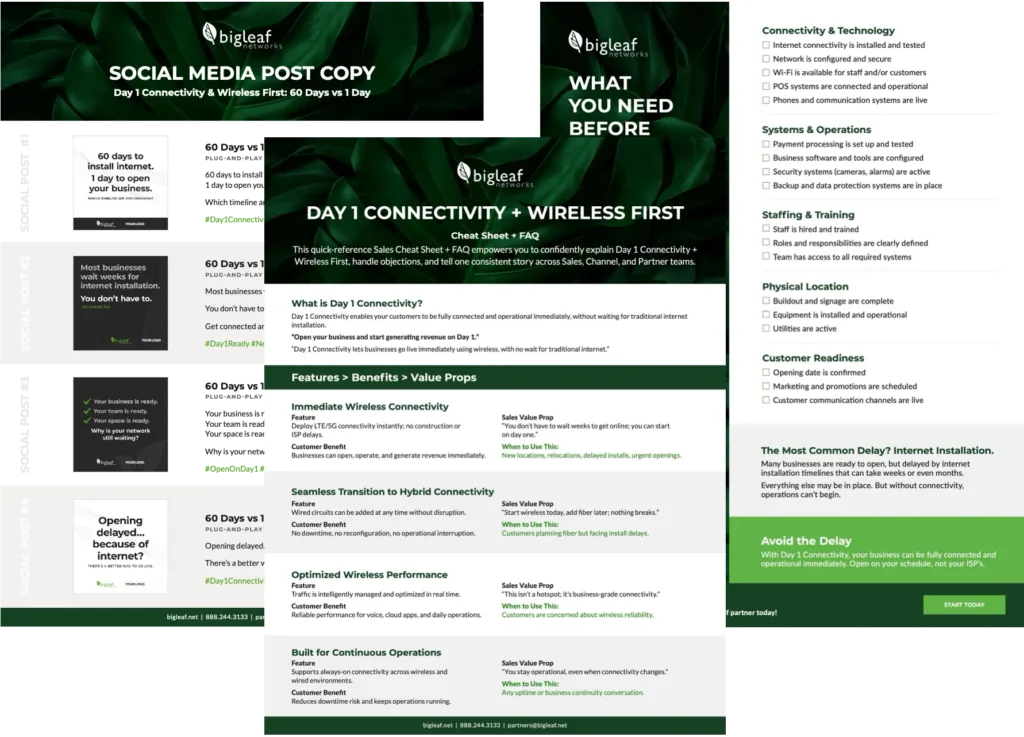
Bigleaf’s Day 1 Connectivity Campaign-in-a-Box gives partners everything they need to help customers get online faster, eliminate installation delays, and start operating on day one.
Inside you’ll find co-brandable sales and marketing assets, email campaigns, social content, battlecards, talk tracks, vertical-specific messaging, and a complete deployment guide—all designed to help you create urgency, start meaningful conversations, and close opportunities faster.
Whether you’re supporting new locations, relocations, franchise expansions, or temporary sites, this campaign makes it easy to position Day 1 Connectivity and Wireless Connect with confidence.
See It in Action
Day 1 Connectivity isn’t just about getting customers online faster. It’s about helping them open locations without delays, avoid lost revenue, and deliver a seamless experience from day one.
Whether it’s a new location, relocation, franchise rollout, or temporary site, Bigleaf Day 1 Connectivity combines Wireless Connect and intelligent network optimization to provide immediate connectivity and business-ready performance.
See how partners are using it to create new opportunities in our on-demand webinar:
