

Why Executive Alignment Is the Foundation of Every Effective Security Program
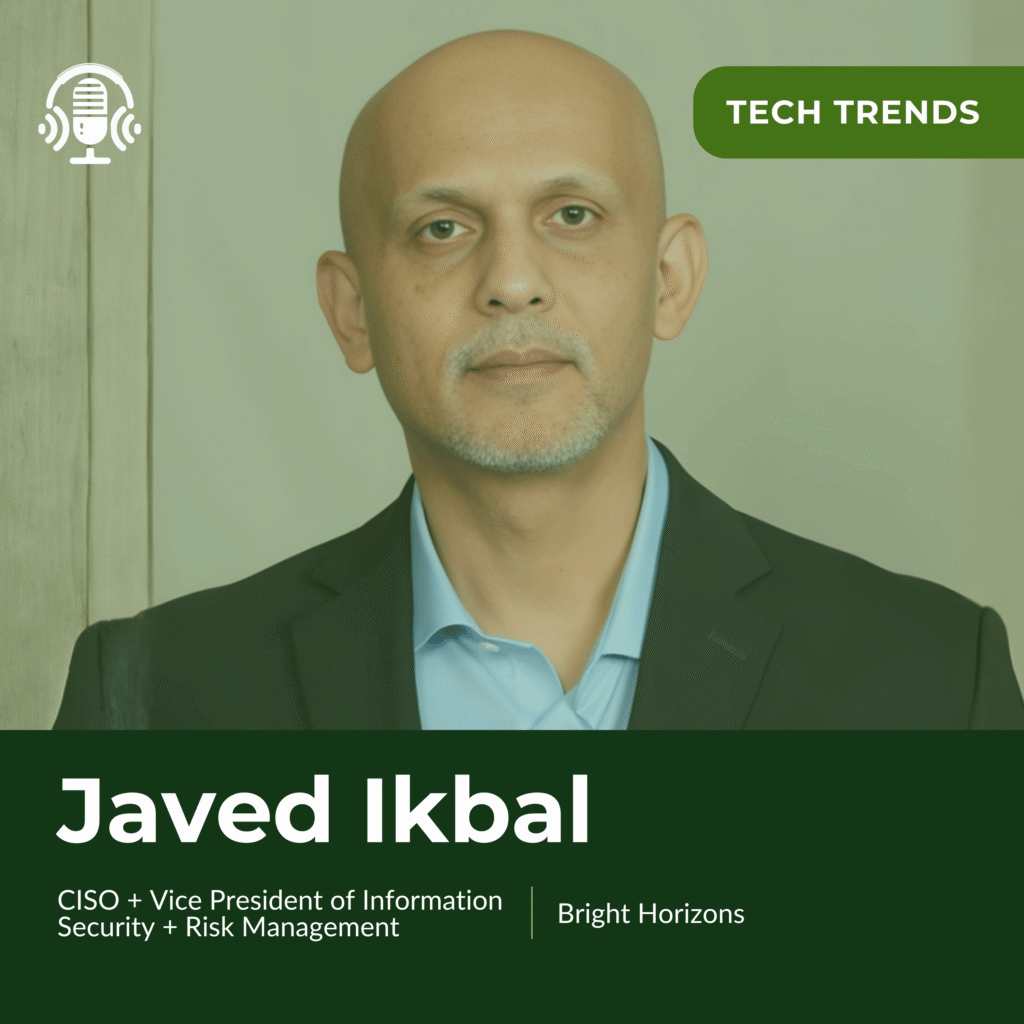
Security programs fail for predictable reasons. Budgets get cut, priorities shift, and the CISO ends up advocating for tools that never get approved. Javed Ikbal, CISO and Vice President of Information Security & Risk Management at Bright Horizons, has spent over 20 years solving exactly that problem. His answer is executive alignment in corporate security, the practice of speaking to the C-suite in terms they understand and act on.
In this episode of Go Beyond the Connection, Javed walks through the principles that shape his approach: failure mode analysis drawn from mechanical engineering, data minimization grounded in the principle of least privilege, and a reframe of the CISO role as revenue protection officer. The result is a security program that earns executive support because it speaks the language of the business.
Threat Modeling as Failure Mode Analysis
Javed’s security instincts go back to dismantling clocks as a child and an undergraduate degree in mechanical engineering. Engineers study failure mode analysis, which is the process of determining exactly when and how a bridge or machine will break before it is built. Javed carried that discipline into information security, where it becomes threat modeling.
“You look at a system or a system of systems and you look at all the threats that can compromise that system, and you put in safeguards,” he explains. By mapping potential failure points before attackers find them, organizations can prioritize controls where they matter most and stop investing in defenses that protect the wrong things.
Data Minimization and the Principle of Least Privilege
The explosion of cheap storage has created a dangerous habit: retaining data indefinitely because it costs almost nothing to keep. Javed argues that this is one of the most underappreciated security risks in enterprise IT. If the data exists, a breach exposes it. If it does not exist, it cannot be stolen.
He extends the principle of least privilege, traditionally applied to system access, to data retention itself. “If we keep unnecessary data, we amplify the impact of a potential breach, making every lost record a liability,” he warns. The CMO, privacy officer, and CISO all have different definitions of what data is necessary. Javed’s framework requires each function to arrive with a concrete use case before any data is retained, a discipline that shrinks the attack surface and simplifies compliance at the same time.
Wireless-First Networks and Endpoint Security
The wireless-first trend is delivering real cost savings by eliminating CAT6 and CAT7 cabling in corporate offices. Javed supports the shift but draws a hard line at dual-homed endpoints. Allowing a device to connect to both a wired corporate network and a wireless network simultaneously creates a bridge that completely bypasses perimeter security, no matter how much the company spent on firewalls.
“We prevent our endpoints from connecting to two separate networks at the same time,” he says. For locations without reliable broadband, he recommends site-to-site gigabit wireless, 5G, or satellite services like Starlink as resilient alternatives that maintain segmentation and control.
Episode Highlights
- How failure mode analysis from mechanical engineering applies directly to cybersecurity threat modeling
- Why cheap storage has made data minimization one of the most overlooked security disciplines
- The specific risk introduced by dual wired-wireless endpoint connections and how Javed’s team prevents it
- Why framing security in terms of revenue, reputation, and regulation unlocks C-suite buy-in
- How to design a security program by back-calculating from breach detection and mitigation questions
SUBSCRIBE & LISTEN >
Related Links:
- Future-Proofing Your Business: How to Embrace Wireless Without Sacrificing Data Security
- Winning Executive Support: How IT Leaders Earn a Strategic Seat
- Bridging the Trust Gap: How IT and Executives Can Align for Scalable Growth
- How Executive Alignment Strengthens Cybersecurity
- Aligning Executive Perspectives to Strengthen Corporate Data Security