

When the Cable Runs Out, You Rethink Everything
Hartsfield-Jackson Atlanta International Airport is not just the world’s busiest airport — it is, by most measures, one of the most operationally complex facilities on the planet. In 2024, more than 108 million passengers moved through its concourses. Every day, 300,000 travelers and 63,000 employees depend on infrastructure that cannot afford to go down. And at the center of it all sits a Chief Information Officer who has made wireless-first network infrastructure the foundation of everything the airport plans to do next.
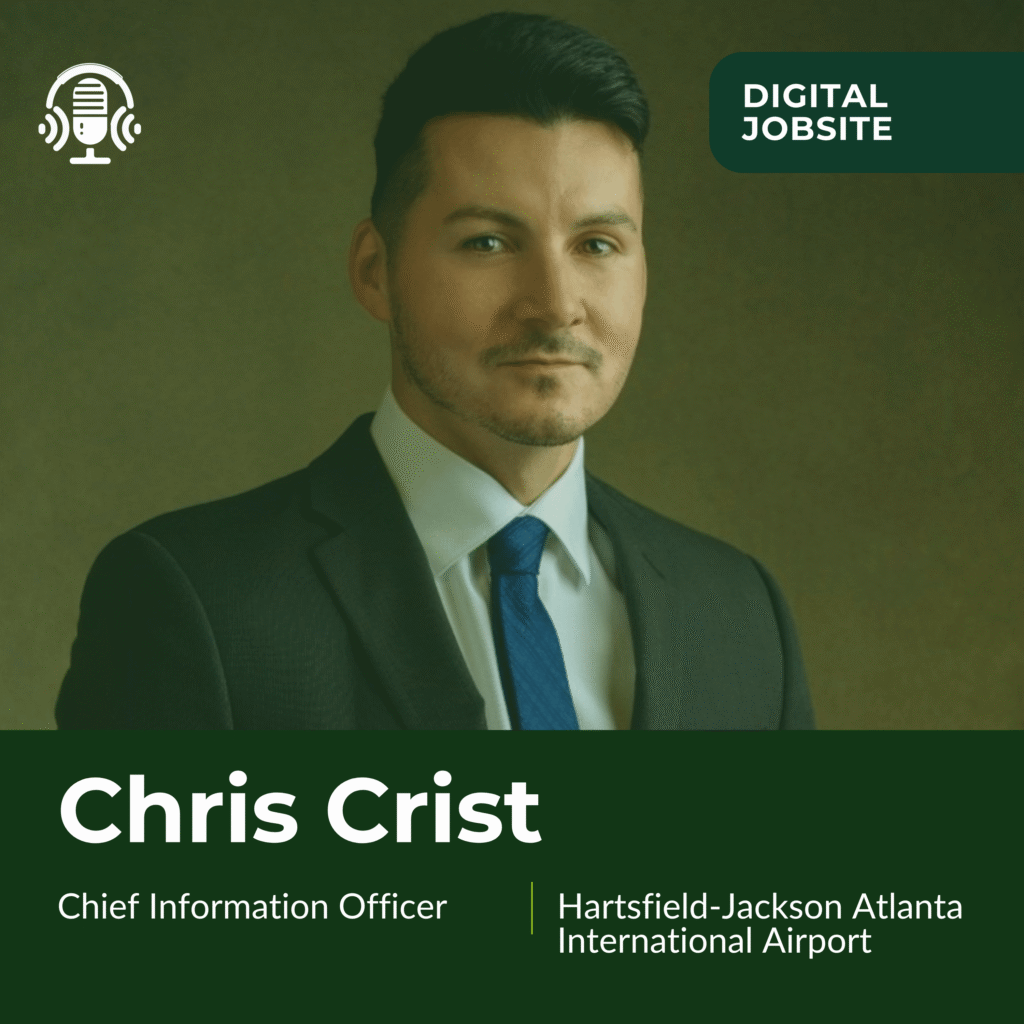
Chris Crist joined Go Beyond the Connection for Episode 017 to talk about what it actually looks like to lead technology at that scale — and why the constraints he inherited became the catalyst for a transformation program that now reaches from the data center floor to the boarding gate.
The trigger was specific: ATL’s main data center reached its physical cabling capacity. There was simply no room to run another wire. Rather than treat this as a facility problem, Crist and his team treated it as a strategic inflection point. The result is a wireless-first architecture that now supports more than 24,000 simultaneous passenger connections, thousands of IoT sensors, biometric boarding technology, and an AI security overlay currently in proof-of-concept across 7,000 cameras.
A CIO Who Demands a Seat at the Executive Table
Before discussing the technology, Crist sets the context: he will not accept a CIO role unless it reports directly to the CEO. That standard is not negotiable, and it is rooted in a clear conviction about how technology leadership works. Organizations that position IT as a support function buried beneath layers of organizational hierarchy are, in his view, organizations that have decided not to use technology as a growth driver.
“There’s a difference between organizations that choose to have their IT department a couple layers down from the CEO and those that have it either directly reporting to the CEO or very closely. In my opinion, it’s an organization that views technology as more of a strategic partner versus one that views it as a tactical initiative.”
At ATL, Crist reports directly to CEO Ricky Smith — a relationship that shapes every investment decision and gives the technology team the authority to lead transformation rather than simply support it.
Wireless at the Scale of a Small City
The airport’s wireless buildout is not a single project — it is a platform. Crist’s team is deploying a state-of-the-art distributed antenna system (DAS) that will cover every area of the airport with high-capacity cellular service by 2026, eliminating dead zones that previously disrupted operations. Alongside the DAS, significant investment is going into upgraded wireless access points, redundant concourse distribution frames, and a new geographically separate data center that provides hot-standby failover for the primary facility.
The IoT dimension alone illustrates why wireless is the only viable path forward. ATL is planning to deploy sensors to detect airborne pathogens in HVAC systems, monitor elevator and escalator health in real time, and track the status of people movers across the facility. Each initiative adds hundreds of connected devices. Wiring all of them is not practical. Wireless makes it possible.
Increasing Access
When 17 access points went down unexpectedly last year, Crist expected complaints about passenger Wi-Fi. What he discovered instead was that airlines had quietly started using the airport’s wireless network as their primary system for passenger check-in and boarding. The outage revealed the depth of operational dependency that had built up without anyone fully accounting for it — a moment that confirmed wireless infrastructure’s status as mission-critical, not optional.
Episode Highlights
- ATL handled 108 million passengers in 2024 with a campus running 24/7 and over 100,000 connected devices
- Physical cabling limits at the main data center triggered the full pivot to a wireless-first architecture
- A new distributed antenna system will provide state-of-the-art cellular coverage throughout the airport by 2026
- In partnership with Delta, biometric facial recognition boarding is active at international gates and expanding
- An AI overlay on 7,000 CCTV cameras is in proof-of-concept, designed to reduce security investigation time from hours to seconds
Listen to the full conversation with Chris Crist on Episode 017 of Go Beyond the Connection, available on your preferred podcast platform. Subscribe to the Go Beyond the Connection LinkedIn newsletter for insights from technology and network leaders across industries.
SUBSCRIBE & LISTEN >
Related Links:
- When Cabling Hits the Limit, Wireless-First Takes Over
- When One Outage Changed Everything: Why ATL Went Wireless-First to Future-Proof Its Network
- Why Wireless-First IT Strategy Is Gaining Executive Attention
- Future-Proofing Your Business: How to Embrace Wireless Without Sacrificing Data Security
- A Wireless First Future: Competitive Advantage Through Seamless Connectivity