

The Hidden Cost of Healthcare Data That Does Not Flow
Most technology leaders understand that healthcare is complex. Fewer talk openly about why that complexity is so hard to fix — or what it actually costs when it does not get fixed. Falko Buttler, Chief Technology Officer at Lantern, addresses both questions directly.
In two key segments from his conversation on Go Beyond the Connection, Falko explains how fragmented healthcare data creates real operational damage, and why the teams that modernize most successfully do it in small, deliberate steps rather than large, high-risk overhauls.
When Standards Exist But Do Not Work
Healthcare has interoperability standards. The expectation is that every provider and hospital system shares patient records across the broader system. In practice, that expectation breaks down constantly.
“Every provider and hospital system is supposed to share medical records and the patient’s history with the broader system. But that doesn’t really happen consistently. That contributes to the friction because you need to try to retrieve that information elsewhere by calling providers or faxing them to get to that data, and that costs time. Ultimately, it leads to delayed care for the patient who really needs help.” — Falko Buttler
The gap between what is supposed to happen and what actually happens is where the operational cost lives. Some providers share records reliably. Others share only parts. Some share nothing at all. Partial participation produces the same downstream chaos as no participation. Teams still have to make calls, send faxes, and manually track down information that should arrive automatically.
 That manual effort adds up. It slows service delivery. It increases administrative overhead, creates delays at exactly the moments when patients need fast, accurate decisions, and puts pressure on every person in the workflow — clinical, administrative, and technical alike.
Price opacity compounds the problem. Falko points out that healthcare is the only industry where you can engage a provider, know exactly what you need, and still walk away without any idea of what it will cost. You can visit ten providers for the same procedure and receive ten different prices. None of those prices reliably reflects the quality of care you will receive. That unpredictability makes planning nearly impossible for employers and patients alike, and it adds another layer of friction to a system that is already hard to navigate.
Why Big Changes Make It Worse
The instinct when facing a broken system is to fix it all at once. Falko argues that instinct is wrong, especially in healthcare, where systems are deeply interconnected and the consequences of disruption reach real people.
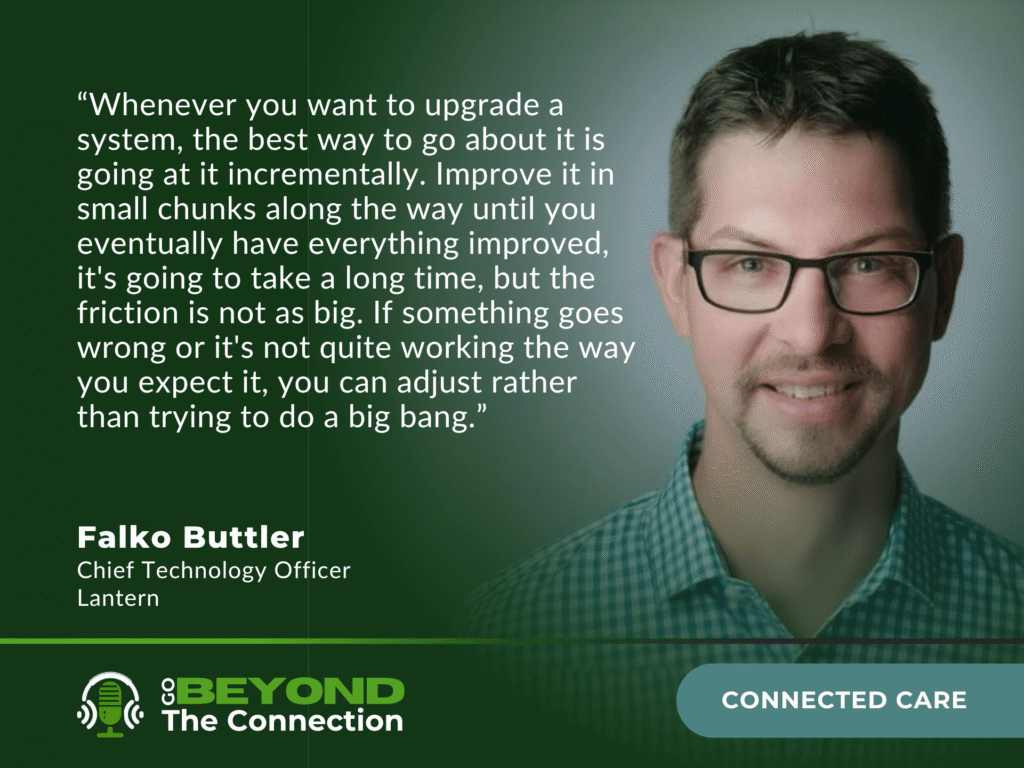
“It’s really hard to change the system all at once. Whenever you want to upgrade a system, whether it is your own legacy system or a broader one, the best way to do it is to do so incrementally, improving it in small chunks along the way, until you eventually have everything improved. It’s going to take a long time, but the friction is not as big.” — Falko Buttler
Incremental change is not a slower path. It is a safer one. Small changes are easier to test. When something does not work as expected, the scope of the problem is narrow and the fix is manageable. You know exactly what changed, and you can roll it back or correct it quickly. That control is nearly impossible to maintain inside a large-scale overhaul where dozens of variables change at once.
Falko connects this directly to how strong engineering teams build software. Continuous delivery, smaller releases, faster feedback cycles. The same logic applies to healthcare modernization at a system level. Each small improvement either works and compounds value over time, or it surfaces a problem early while the cost to fix it is still low.
What This Means for Technology Leaders
Fragmented data and the pressure to modernize are not problems unique to Lantern or to healthcare. They are familiar to any technology leader managing complex, interconnected systems where downtime and disruption have real consequences.
The path forward is not a single bold initiative. It is a disciplined sequence of improvements, each one tested, validated, and built on the one before it. That approach requires patience. It also requires a network and infrastructure foundation that stays reliable while change is happening around it.