
The Problem With Forward-Only Planning
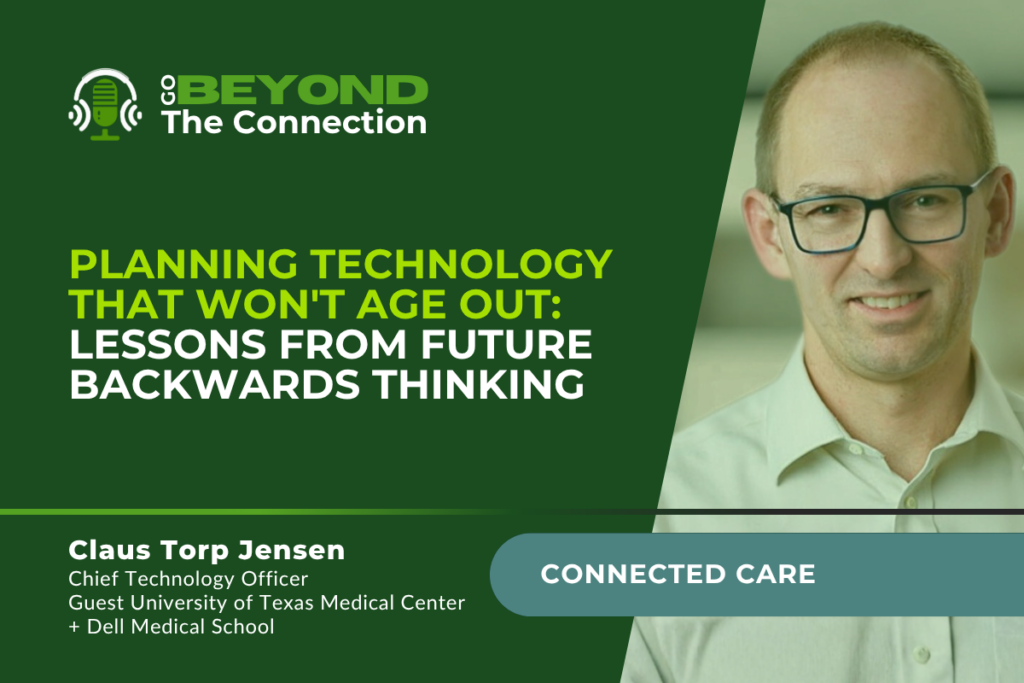
Most technology strategies are built to solve today’s problems. In a conversation on Go Beyond the Connection, Claus Torp Jensen, Chief Technology Officer at the University of Texas Medical Center and Dell Medical School, explains why that approach almost guarantees disappointment — and what to do instead.
Technology leaders rarely set out to build systems that expire early, yet it happens constantly. Facilities open outdated. Networks strain under new demands. Platforms that looked modern on paper fail to adapt when workflows change. The culprit, according to Claus, is a planning model that starts from today’s constraints and optimizes within them.
In healthcare, the stakes are especially visible. Academic medical centers take a decade to build. By the time the doors open, clinical science, logistics, and technology have all moved. As Claus puts it, for the vast majority of them, when they opened, they’re outdated. That is not a funding problem or a talent problem. It is a planning problem — and future backwards thinking is the fix.
Using the Future as a Design Constraint
Future backwards thinking flips the planning model. Instead of asking what can be done now, leaders define what must be possible later and engineer backward from that destination. The process does not require perfect forecasts. It requires clarity about outcomes.
“Nobody can predict the future, but you can prepare for it. Ask yourself, where do you want to be in 2040? It’s mind-boggling how it changes the conversation if you start with the future and then you try to go backwards.”
– Claus Torp Jensen, Chief Technology Officer, University of Texas Medical Center + Dell Medical School
This reframing changes how tradeoffs are evaluated. Roadmaps are assessed based on whether they move the organization closer to its long-term destination, not just whether they solve an immediate problem. Budgets align to outcomes. Standards are set with longevity in mind. Procurement choices favor modularity and interoperability rather than the cheapest option that works today.
Facilities That Anticipate How Care Will Evolve
Healthcare makes the risk of short-term thinking more visible than most industries, but the principle applies broadly. When Claus and his team ask what 2040 requires, they arrive at specific, actionable decisions: corridors wide enough for humans and robots to share space without dedicated lanes; production labs that support individualized pharmaceutical and biological therapies manufactured at the point of care; patient lounges that replace traditional waiting rooms with functional spaces for wearable pickup, program enrollment, and supervised waiting.
These are not bets on specific devices or workflows. They are capacity choices — decisions that leave room for new models of care to emerge without forcing a rebuild every five years. The building does not just enable the care team. In Claus’s framing, it becomes part of the care team.
When the Network Carries Clinical Responsibility
As care becomes more digital and sensor-driven, network reliability inherits clinical weight. Remote surgical presence, real-time monitoring, and large-scale edge computing all depend on uninterrupted connectivity. Claus argues that networks must be engineered as safety systems, not utilities — with redundancy across wired and wireless paths, continuous failover testing, and governance that includes clinicians and operations leaders, not just IT.
The shift is both technical and organizational. Measuring uptime as a patient-facing outcome rather than an infrastructure metric changes what gets funded, who gets a seat at the table, and how success is defined. In a world where the network is the business, those conversations cannot happen in the technology team alone.
Leadership That Sustains the Marathon
Long-horizon strategies succeed only when people stay aligned over years of change — not just through a project launch. Claus names storytelling as the discipline that holds transformation together. Clear narratives connect daily decisions to a shared destination. They help teams adapt as technology shifts without losing direction, and they sustain the conviction and culture that a decade-long program requires.
Future backwards thinking provides more than a planning framework. It gives technology leaders a reasoned story about where the organization is going and why each choice along the way matters. That story is what makes the marathon sustainable.
KEY TAKEAWAYS
- Forward-only planning leads to early obsolescence, especially in industries with long build cycles
- Future backwards thinking aligns every decision to a long-term destination rather than current constraints
- Facilities should be designed for adaptability and human-robot collaboration, not fixed workflows
- Networks must be treated as mission-critical safety systems with genuine redundancy and clinical co-ownership
- Storytelling and people leadership are the infrastructure that sustains long-horizon change
Hear the full conversation with Claus Torp Jensen on the Go Beyond the Connection episode page. To learn more about how Bigleaf supports mission-critical connectivity, visit bigleaf.net.
Related Links:
- Future Backwards Thinking: How CTOs Should Build Today’s Technology Strategy
- Breaking the Box: Why Future Backwards Thinking Changes How Leaders Plan
- The Network Is the Business: Why Connectivity Defines Outcomes
- Why medical offices and care facilities rely on Bigleaf
- How Innovation Centers Navigate AI Hype and Deliver Real Results
- Watch the YouTube Playlist of video episodes
- Watch the YouTube Shorts Playlist
- Subscribe to the LinkedIn Newsletter
- Listen on Captivate: Go Beyond the Connection