

When the Network Becomes a Strategic Advantage
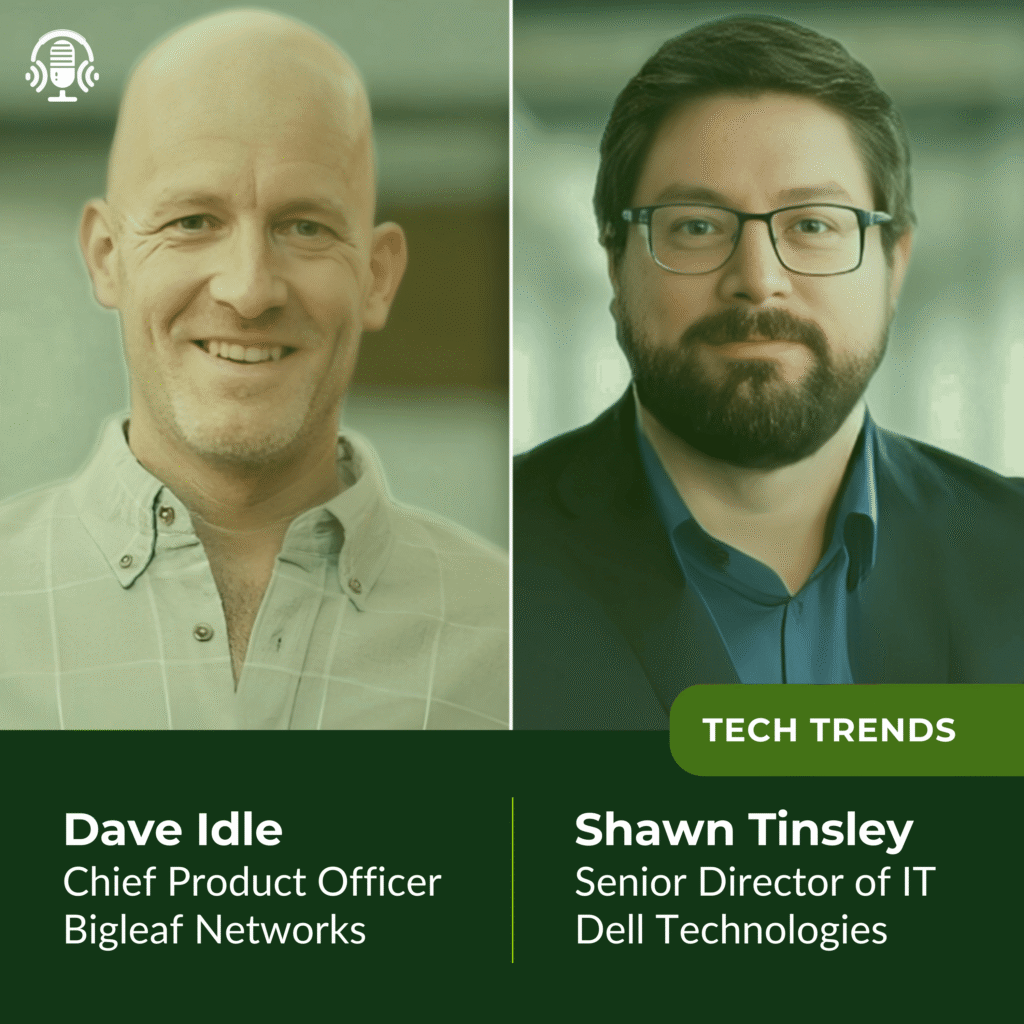
Enterprise IT has spent a decade wrestling with the same fundamental tension: the business needs to be everywhere, but the infrastructure was built for fixed locations. Shawn Tinsley, Senior Director of IT at Dell Technologies, and Dave Idle, Chief Product Officer at Bigleaf Networks, bring two distinct vantage points to that tension on this episode of Go Beyond the Connection. Together they map out what a wireless-first network strategy actually looks like at enterprise scale, and why the companies still treating 5G as a backup are already falling behind.
Shawn frames the shift precisely: the network has evolved from a fixed physical resource to a service layer. That means no single location constrains what the network can do. Infrastructure becomes adaptable, deployable, and reconfigurable across every edge the business touches, whether that is a warehouse, a restaurant location, an offshore rig, or a pop-up field site.
Zero-Touch Failover and the End of Planned Downtime
Dave explains how Bigleaf’s approach to multi-circuit bonding eliminates the downtime window that traditional failover solutions create. When a primary circuit fails, older architectures detect the outage, trigger a switch, and then wait for every device on the network to recognize the new connection and reconnect. That process can take up to 20 minutes for POS systems and IoT devices. During that window, transactions fail, compliance cameras go dark, and operations stop.
With Bigleaf, the secondary circuit is already active. Traffic routes across the cleanest available path in real time, and the failover happens without the network noticing. Point-of-sale systems keep running. VoIP calls stay connected. IoT devices do not reboot.
“With Bigleaf, you’re connected directly to our appliance, so if one connection goes down, your network never even notices. Our secondary circuit is already live and automatically takes over traffic, ensuring that critical applications like point of sale, IoT devices, or VoIP, none of those is impacted in any way.”
— Dave Idle, Chief Product Officer, Bigleaf Networks
Wireless-First at the Edge: From Oil Platforms to Franchise Networks
Shawn grounds the conversation in the realities he has seen firsthand. On an offshore oil platform ten miles out, stringing wireline cable is not an option. Teams that were navigating 20-year-old loose-leaf binders can now access live documentation, diagnostics, and scheduling systems on 5G-enabled tablets. The same logic applies to construction management firms running 200 active sites, regional franchise operators managing compliance-sensitive environments, and field service organizations whose technicians need to resolve issues on the first visit.
Dave extends the point to the monitoring layer. Because Bigleaf provides visibility into packet loss, latency, and jitter across every circuit, a single network engineer can see the health of a hundred locations from one dashboard, identify the four that are running on their secondary connection, and address the carrier issue in the background without disrupting the customer at that site.
Episode Highlights
- 5G now matches or exceeds traditional broadband speeds in most business scenarios, and continues to improve
- Dynamic circuit bonding allows businesses to bond up to four connections, including 5G, fiber, satellite, and cable, across a single intelligent routing layer
- Most enterprises use roughly a quarter of their purchased bandwidth capacity, Bigleaf’s monitoring surfaces the real utilization picture
- AI and machine learning sit inside Bigleaf’s platform today, testing circuits ten times per second and classifying traffic by application type
- The shift from fixed resource to service layer means the network is no longer a constraint on where the business can operate
If you are responsible for network infrastructure across distributed locations, this conversation will sharpen how you think about resilience, cost, and the next infrastructure decision on your roadmap. Listen to the full episode and subscribe to Go Beyond the Connection on your favorite podcast platform.
SUBSCRIBE & LISTEN >
Related Links:
- Edge to Enterprise WAN Resilience with 5G
- How IT Partnerships Drive Internal Success
- Empowering Field and Offshore Teams with Wireless-First Tools
- A Wireless First Future: Competitive Advantage Through Seamless Connectivity
- Why CIOs Are Turning to Wireless-First Network Infrastructure
- Future-Proofing Your Business: How to Embrace Wireless Without Sacrificing Data Security